
 Español
 Português
  русский
  Français
  日本語
日本語  Deutsch
  tiếng Việt
  Italiano
  Nederlands
  ภาษาไทย
  Polski
  한국어
한국어  Svenska
  magyar
  Malay
Malay  বাংলা ভাষার
  Dansk
Dansk  Suomi
Suomi  हिन्दी
  Pilipino
  Türkçe
  Gaeilge
  العربية
  Indonesia
  Norsk
Norsk  تمل
تمل  český
český  ελληνικά
  український
  Javanese
  فارسی
فارسی  தமிழ்
தமிழ்  తెలుగు
  नेपाली
  Burmese
  български
  ລາວ
ລາວ  Latine
  Қазақша
  Euskal
  Azərbaycan
  Slovenský jazyk
  Македонски
  Lietuvos
  Eesti Keel
  Română
  Slovenski
  मराठी
मराठी  Srpski језик


When Sarah’s daughter called, she sounded worried.
Her mother was 68. She had been diagnosed with Alzheimer’s disease a year earlier and had been taking her prescribed medication as directed.
Over the past six months, though, her memory had declined faster than the family expected.
She would forget where she had put the groceries she bought just the day before. Sometimes, she would stare at her daughter and son-in-law for a long time, unable to say their names even though the words seemed to be right on the tip of her tongue.
Not long ago, she went out for a walk and nearly couldn’t find her way home.
Her daughter asked:
“The doctor said there’s no cure for this disease. All we can do is try to slow it down.”
“I’d like to give her folate and vitamin B12. I’ve seen people online saying they may help with dementia.”
“But she’s already taking medication. Could the supplements interact with it?”
“Can she take them at all? And if so, how much would be appropriate?”
Many caregivers have asked similar questions.
When an older family member’s condition changes, it is natural to feel anxious. But a nutrient should not be purchased and taken simply because someone says it helped them.
Note: This is a fictional case created to help explain the relevant scientific mechanisms.
A Chinese Study Offers Some Clues
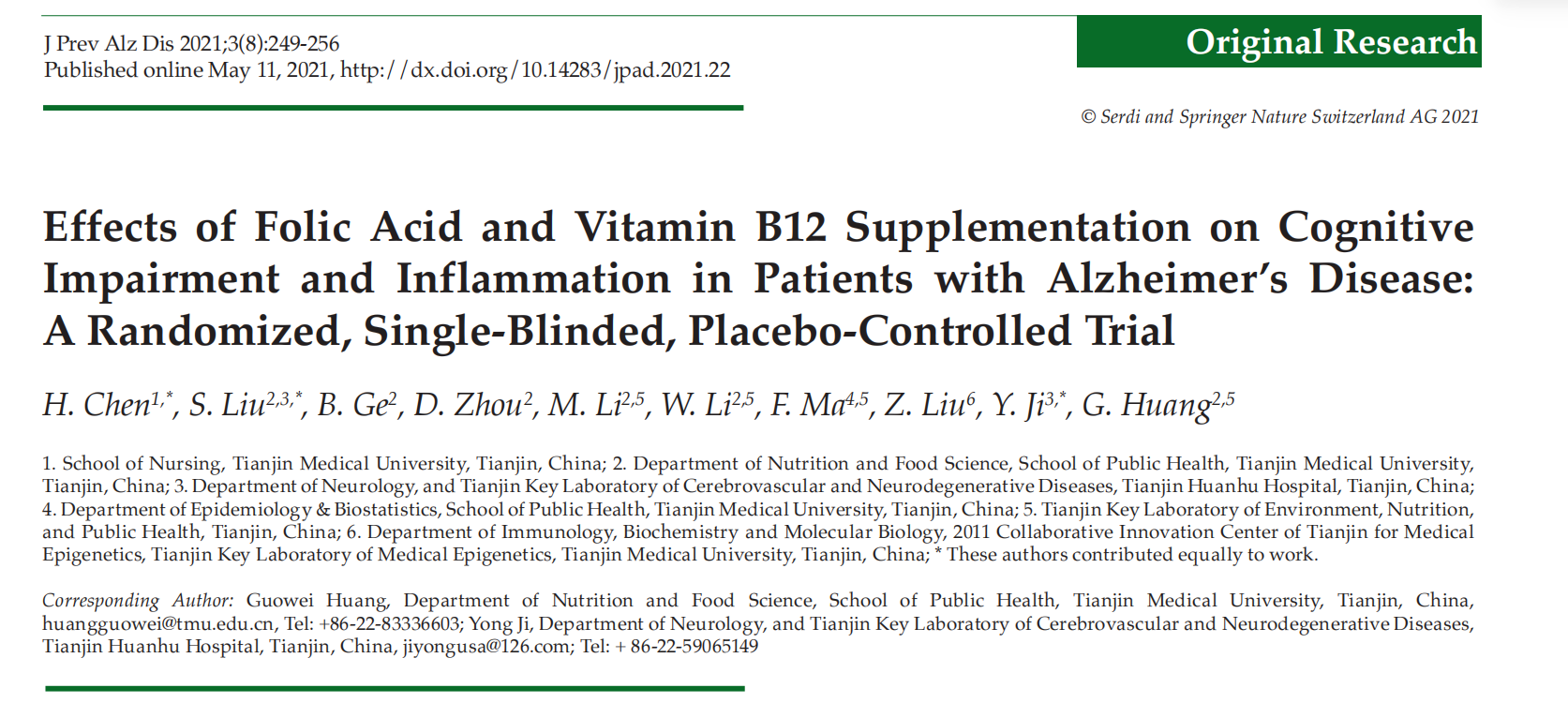
In 2021, a research team from Tianjin Medical University and Tianjin Huanhu Hospital published a randomized, single-blind, placebo-controlled study.[1]
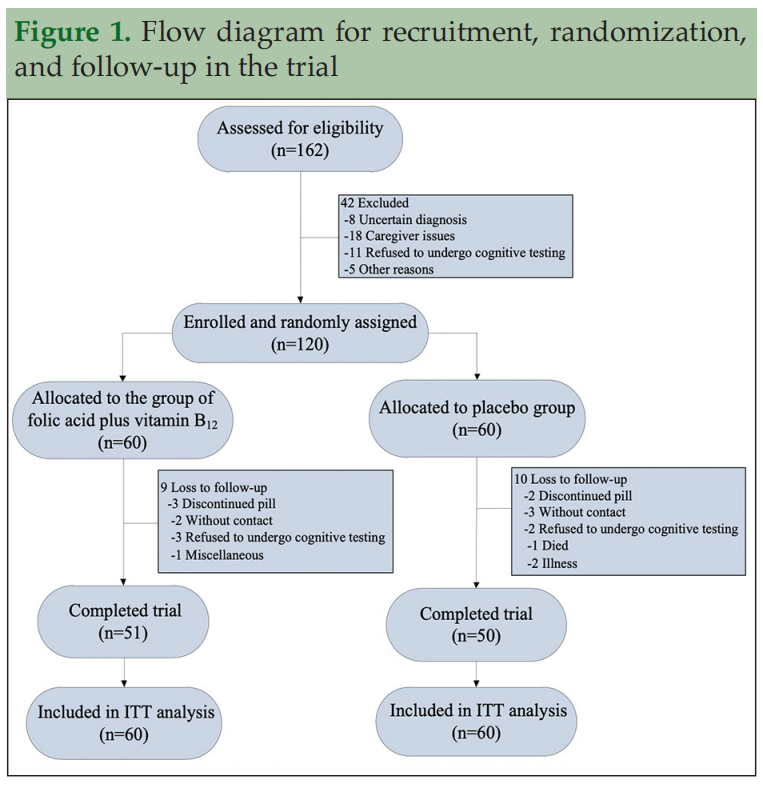
The study included 120 Chinese patients who had already been diagnosed with Alzheimer’s disease. None of them stopped their existing standard medications.
One group took folic acid 1.2 mg and vitamin B12 50 μg every day. The other group received a placebo.
The observation period lasted six months.
Several of the findings are worth looking at.
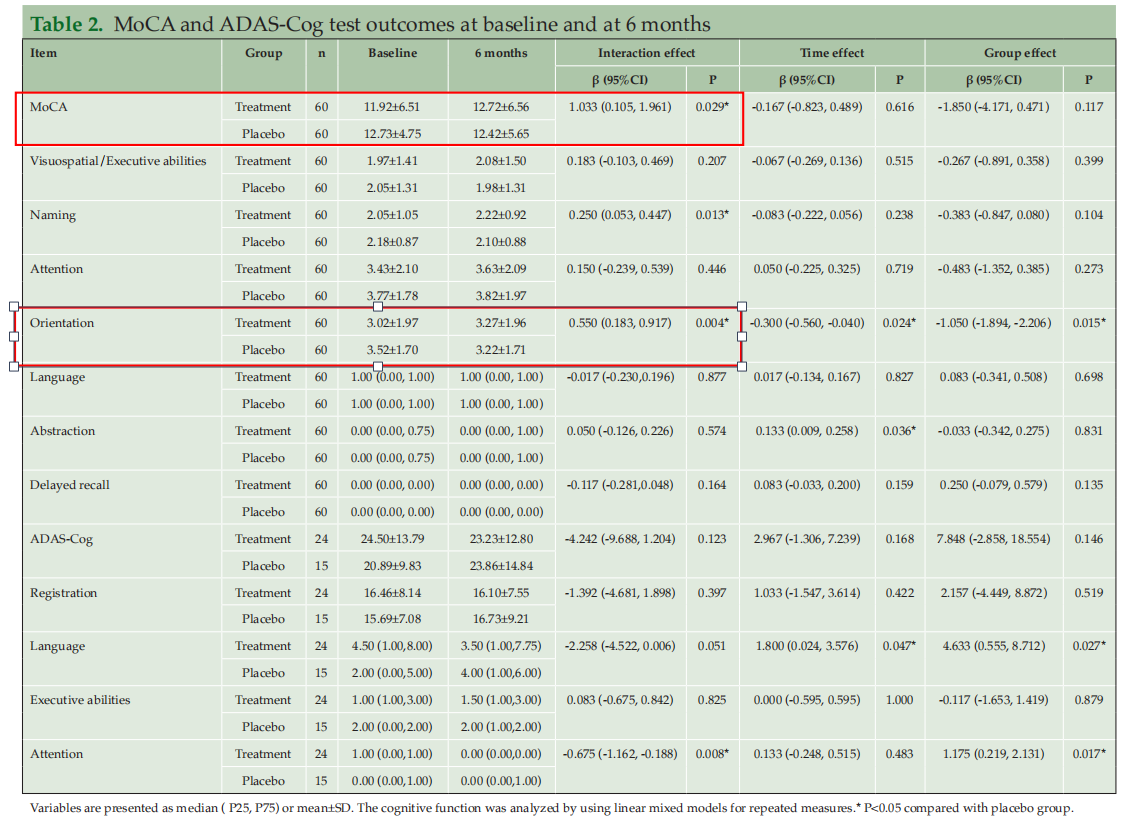
In the supplementation group, the average MoCA cognitive score rose from 11.92 to 12.72, an increase of 0.80 points. In the placebo group, the score fell from 12.73 to 12.42, a decrease of 0.31 points.
The difference between the two groups was statistically significant, with P=0.029.
The change in orientation was particularly notable: β=0.550, P=0.004.
In simple terms, orientation refers to whether a person can correctly recognize the time, place, and people around them. At home, that might mean knowing what day it is or still being able to recognize the way home after going out.
The study also looked at homocysteine, commonly referred to as Hcy.
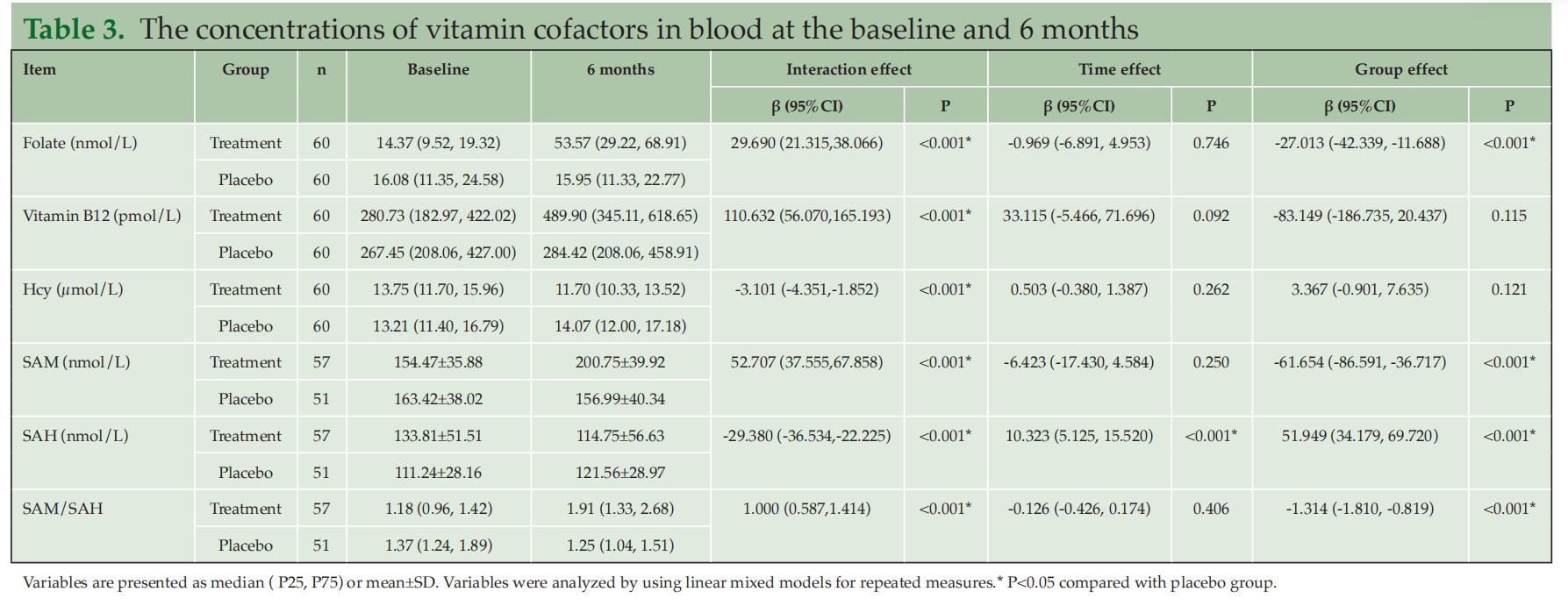
Hcy levels in the supplementation group fell by approximately 3.1 μmol/L, with P<0.001.
At the beginning of the study, 91.67% of the 120 participants had Hcy levels above 10 μmol/L.
The researchers also observed a decrease in TNF-α, an inflammation-related factor associated with neuroinflammatory activity.
That is a signal worth studying further, but the evidence only supports that much.
It would be an overstatement to see changes in a few indicators and conclude that folate and vitamin B12 can treat Alzheimer’s disease.
The study examined an adjunctive nutritional intervention for patients who had already been diagnosed and were receiving standard treatment. It did not replace their existing medication.
How Folate and B12 May Be Involved
Let’s start with Hcy.
Elevated homocysteine has been associated with cognitive decline and problems affecting cerebrovascular health. When Hcy is high, it may occur alongside oxidative stress, damage to the vascular endothelium, and inflammatory responses.
Brain tissue is highly sensitive to changes in blood flow, oxygen, and energy supply. If metabolism remains disrupted over time, neurological function may also be affected.
Folate and vitamin B12 are both involved in one-carbon metabolism. This process is connected with the recycling of Hcy and the production of methyl donors.
One indicator often discussed in this area is the SAM/SAH ratio. It reflects part of the body’s methylation capacity.
DNA methylation plays a role in regulating gene expression, and this pathway has continued to attract attention in Alzheimer’s research.
Then there is inflammation.
The change in TNF-α mentioned above only shows that the study observed an associated phenomenon. There is research linking neuroinflammation with the progression of Alzheimer’s disease, but it is still too early to say how much nutritional supplementation can influence the course of the disease.
A proposed mechanism can help explain certain observations. But a mechanism that makes biological sense does not mean everyone will experience the same result after taking a supplement.
Where Ordinary Folic Acid May Fall Short
The Tianjin study used ordinary synthetic folic acid.
Some people may ask: Doesn’t folate need to be converted in the body before it can be used? If so, does ordinary folic acid have much value?
It would be too simplistic to draw that conclusion.
After folate enters the body, it passes through several metabolic steps before becoming the active form that cells can use relatively easily: 6S-5-methyltetrahydrofolate.
The MTHFR enzyme is involved in one of these steps.
The MTHFR C677T genetic polymorphism can affect the efficiency of this metabolic process. Epidemiological studies in Chinese populations show that the MTHFR C677T variant is relatively common.[2]
People with different genotypes may have different enzyme activity and Hcy levels.
But a genetic report is not a verdict.
Someone with the CT genotype may still have normal Hcy. Someone without an obvious related variant may still develop elevated Hcy because of diet, kidney function, thyroid function, age, medication use, or other factors.
That is why a genetic test alone cannot answer every question. Hcy, folate, vitamin B12, and genotype need to be considered together.
What to Clarify Before Testing
There are many possible causes of cognitive decline.
If memory problems persist, orientation becomes impaired, or behavior changes noticeably, the first step is to see a neurologist or visit a memory clinic. When assessing nutritional and metabolic factors, doctors will usually consider several tests.
The first is Hcy.
Reference ranges vary across countries and regions. In relevant Chinese consensus documents, an Hcy level above 15 μmol/L is often used as a reference threshold for elevation.
If the result is high, or close to the upper limit, it should not be interpreted in isolation. Kidney function, dietary habits, and current medications all need to be considered.
The second is folate and vitamin B12.
A high Hcy level is not necessarily caused by a folate problem alone. Vitamin B12 deficiency, changes in kidney function, thyroid dysfunction, and medications such as metformin and proton pump inhibitors can all affect the results.
If you focus only on folate, a B12 problem can easily be missed.
The third test to consider is the MTHFR genotype.
Common C677T results include CC, CT, and TT.
What Happened to Sarah Zhou
Later, at her doctor’s recommendation, Sarah Zhou had her Hcy, folate, vitamin B12, MTHFR genotype, and thyroid function tested.
Her Hcy level was 18.6 μmol/L, above the reference range. Her folate and vitamin B12 levels were still within the laboratory reference ranges, and her MTHFR genotype was CT.
The doctor did not dismiss the issue with a simple “just take folate.”
Instead, the doctor considered her medication use, diet, and overall health, adjusted her nutritional management plan, and arranged regular cognitive follow-up.
Three months later, her Hcy had returned to the reference range, and her memory assessment score had not declined further.
Still, the change during this period cannot be attributed entirely to one nutrient.
Standard medication, regular follow-up appointments, the caregiving environment, sleep, and overall nutritional status may all have played a role.
A temporarily stable score does not mean that the risk or progression of Alzheimer’s disease has changed. Continued follow-up is still necessary.
With this disease, there are no shortcuts.
Assess First, Then Supplement
Looking at Hcy, folate, vitamin B12, and the MTHFR genotype together is usually more informative than focusing on any single result.
The regimen used in the Tianjin study was 1.2 mg of folic acid plus 50 μg of vitamin B12 per day.
That was the intervention dose used in the study. It is not a routine daily supplementation plan that everyone should copy.
After taking supplements for a period of time, patients can have Hcy and other relevant indicators rechecked under medical supervision. The trend can then be assessed before deciding whether any adjustment is needed.
If cognitive symptoms continue to progress, do not stop or change prescribed medication simply because you have started taking nutritional supplements.
Caring for someone with Alzheimer’s disease rarely comes with an answer that works overnight.
What can be done is to examine each factor that may affect the condition, one by one. Standard treatment, nutritional status, and long-term follow-up all matter.
References
[1] Chen H, Liu S, Ge B, et al. Effects of Folic Acid and Vitamin B12 Supplementation on Cognitive Impairment and Inflammation in Patients with Alzheimer’s Disease: A Randomized, Single-Blinded, Placebo-Controlled Trial. Journal of Prevention of Alzheimer’s Disease, 2021, 8(3):249–256. doi:10.14283/jpad.2021.22.
[2] Yang B, Liu Y, Li Y, et al. Geographical Distribution of MTHFR C677T, A1298C and MTRR A66G Gene Polymorphisms in China: Findings from 15,357 Adults of Han Nationality. PLoS ONE, 2013, 8(3):e57917. doi:10.1371/journal.pone.0057917.
[3] Lian Zenglin, Liu Kang, Gu Jinhua, Cheng Yongzhi, et al. Biological Characteristics and Applications of Folate and 5-Methyltetrahydropteroic Acid. China Food Additives, Issue 2, 2022.
Further Reading: Media Reports
China Food News. “Jinkang Hexin Uses Naturalization folate to Support Health Throughout the Life Cycle.” April 27, 2026.
https://www.cnfood.cn/article?id=2048574550954840066
Xinhua News Client. “Integrating Nutritional Fortification into Everyday Meals: Policy and Technology Accelerate Food Fortification.” April 21, 2026.
https://app.xinhuanet.com/news/article.html?articleId=20260421b6c54036c6ad4c12934a893bef452fe5
Risk Disclosure
Magnafolate® is supplied solely as an active folate raw material in the form of calcium 6S-5-methyltetrahydrofolate. It does not provide diagnostic or treatment recommendations directly to consumers.
The Tianjin study discussed in this article involved patients who had already been diagnosed with Alzheimer’s disease and examined adjunctive nutritional intervention alongside standard drug treatment. It cannot replace medical treatment or be used as a preventive measure.
Folate, vitamin B12, and any other nutritional supplementation plan should be evaluated by a doctor or qualified nutritionist based on the individual’s health status.
The people described in this article are fictional. The details are included only to explain the background of the study.
This article is intended for science education and industry discussion. It does not replace medical or nutritional advice. Dietary supplements are not intended to diagnose, treat, or prevent disease. People planning to conceive, pregnant women, individuals with chronic conditions, and anyone taking medication should consult a qualified professional before use.


 Online Service
