
 Español
 Português
  русский
  Français
  日本語
日本語  Deutsch
  tiếng Việt
  Italiano
  Nederlands
  ภาษาไทย
  Polski
  한국어
한국어  Svenska
  magyar
  Malay
Malay  বাংলা ভাষার
  Dansk
Dansk  Suomi
Suomi  हिन्दी
  Pilipino
  Türkçe
  Gaeilge
  العربية
  Indonesia
  Norsk
Norsk  تمل
تمل  český
český  ελληνικά
  український
  Javanese
  فارسی
فارسی  தமிழ்
தமிழ்  తెలుగు
  नेपाली
  Burmese
  български
  ລາວ
ລາວ  Latine
  Қазақша
  Euskal
  Azərbaycan
  Slovenský jazyk
  Македонски
  Lietuvos
  Eesti Keel
  Română
  Slovenski
  मराठी
मराठी  Srpski језик


As we mentioned in the previous episode, 78.4% of the Han population in China has MTHFR gene polymorphism. Ordinary folic acid cannot be absorbed and utilized by the body effectively. Even with consistent supplementation, homocysteine (HCY) levels remain difficult to lower, leaving the body in a long-term state of nutritional deficiency.
After the article was published, we received a large number of messages in the background:
"I understand all the principles, but I always forget to take folic acid tablets."
"Is there an easy way to supplement folate that requires no persistence and suits everyone?"
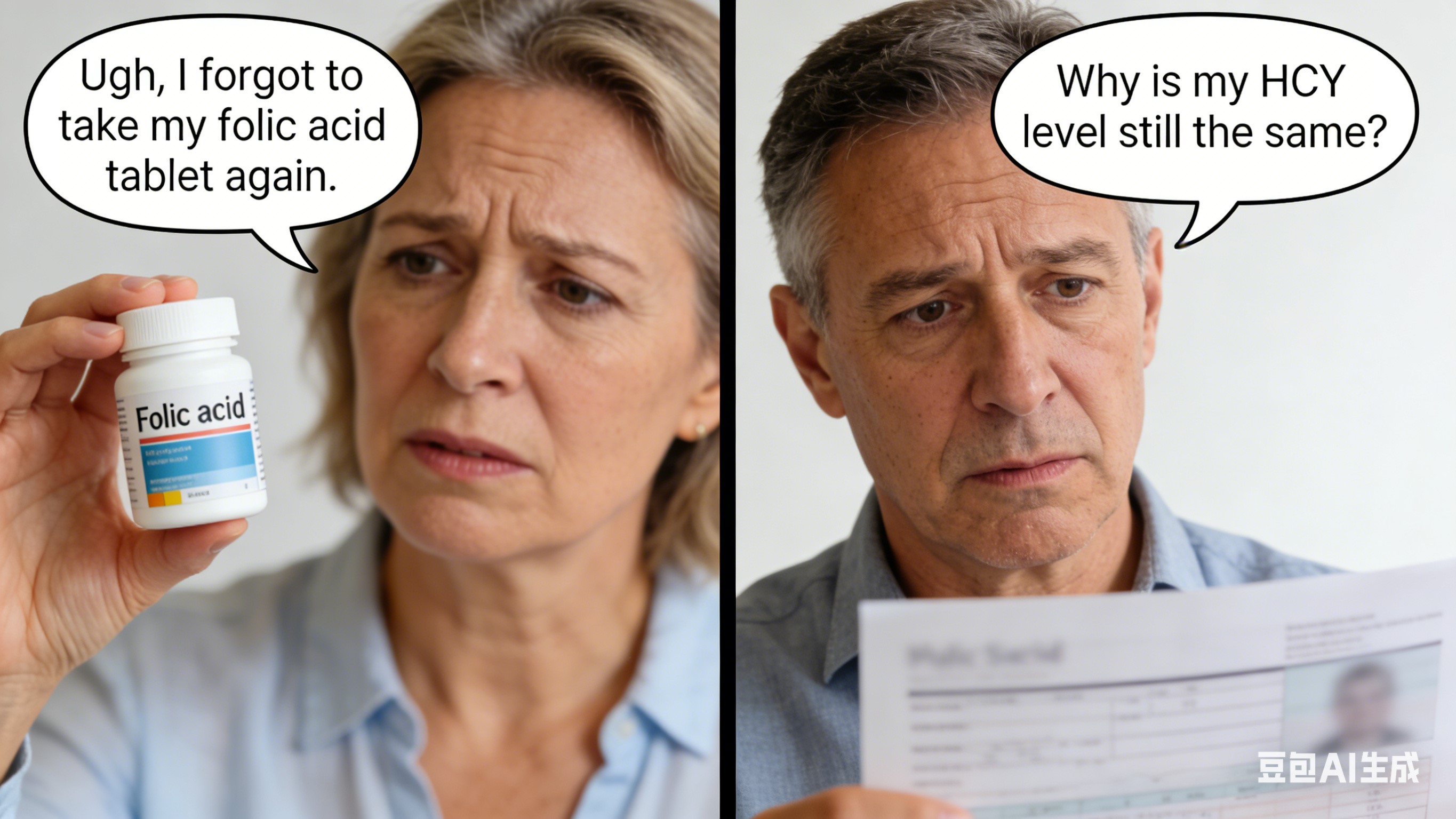
Today, let's cut straight to the conclusion: Most people choose the wrong way to supplement folate from the very start. The most suitable folate supplementation solution for Chinese people is not pills, but the staple foods we eat every day.
I. Why is supplementing folic acid with pills hard to stick to and ineffective?
For a long time, our understanding of folate has been trapped in two misconceptions. We either regard it as a "medicine exclusively for pregnancy preparation" or a "health supplement for the elderly", ignoring that it is an essential B-complex vitamin for people of all ages every single day.
Supplementing with pills inherently has two unavoidable drawbacks:
Poor compliance: People are inherently resistant to taking pills. Expectant mothers struggle to keep up long-term use; busy middle-aged people often forget doses; the elderly tend to get confused. Steady daily supplementation is nearly impossible. This causes fluctuating folate levels in the body, greatly undermining the nutritional benefits.
An unavoidable national metabolic genetic barrier: Even if you take it on time every day, 78.4% of Chinese people are restricted by MTHFR genetic defects. The liver cannot convert folic acid into the active form usable by the body. Most unutilized folic acid accumulates in the body as unmetabolized folic acid — this is the main reason why many people see no change in HCY levels even after taking folic acid for half a year.
II. Why are staple foods the best way for Chinese people to supplement folate?
To solve the nationwide problem of folate deficiency, we must align with Chinese people's daily habits. What is something we rely on for three meals a day, never need to remember to take, and is consumed by people of all age groups? There is only one answer: wheat flour.
Northerners can't live without steamed buns and noodles at every meal, while southerners often eat dumplings, baozi, wontons and bread. Wheat flour is a staple deeply rooted in the dietary genes of Chinese people. Fortifying it with folate offers three irreplaceable advantages that folate pills can never match:
No need to set alarms or remember to take pills — you supplement folate simply by eating meals, bringing compliance to its peak naturally. Everyone, men and women, young and old, families planning pregnancy, and middle-aged & elderly groups alike can get folate effortlessly. It truly integrates into daily diet with no deliberate supplementation required.
Continuous micro-dose supply with doubled absorption rate: Distributed intake across three meals perfectly matches the body's folate metabolism rhythm. It keeps blood folate levels stable throughout the day without high-dose waste, delivering far higher nutritional utilization than oral tablets.
Universal necessity with low market education costs: The health benefits of folate are widely recognized by the public, so there is no need for ground-up market education. It only needs to be communicated that "This fortified flour provides active folate naturally with every meal" — a message easy for everyone to understand at once.
III. If folate-fortified flour is so beneficial, why is it barely seen in supermarkets?
It is not that the direction of folate-fortified flour is wrong. Instead, the timing was not mature in the past, and the core raw materials could never break through the application bottlenecks.
Today, the two core barriers that have troubled the industry for decades have been completely overcome. Folate-fortified flour has officially entered the best window period for market implementation!
In the past, folate-fortified flour always remained in the pilot stage and never truly entered the national market. Today, it has evolved from a policy-based nutritional supplement into a daily necessity for the general public, becoming a new high-end track for grain and oil enterprises to break free from fierce market homogenization competition.
In the early days of China, folate-fortified flour was only targeted at pilot programs to improve nutrition in remote and impoverished areas. As a policy-based supply for addressing public health shortcomings, it was distributed exclusively in designated regions and never circulated in supermarkets nationwide. This is the fundamental reason why the public can hardly find it in stores.
Nowadays, the Healthy China Initiative, the National Nutrition Plan, and preventive healthcare have all risen to top-tier national development strategies. Consumption of staple foods is upgrading, and demand for precise nutrition among the general public is booming rapidly. Folate fortification has completely shaken off its image as a niche nutritional supplement and become a market-driven daily necessity for families across the country.
In the past, the industry generally believed that "folate cannot withstand high temperatures and is easily lost during processing" was the biggest challenge. In fact, this is only a minor issue that can be solved through microencapsulation technology. What has locked the industry in place for decades are the two critical bottlenecks of compliance and efficacy — which were completely resolved only after the launch of Magnafolate®.
First, the compliance barrier. Before 2025, active folate (6S-5-methyltetrahydrofolate calcium) was not approved by the state for use in wheat flour. Even if enterprises wanted to develop related products, they could not add it legally. Folic acid, which was permitted for addition, fell into an awkward situation of being usable yet ineffective, making it impossible to support the commercialization of formal products. It was not until 2025 that the National Health Commission officially approved Magnafolate® (C-crystal form) as a nutrient fortifier for wheat flour. This has removed the final regulatory obstacle and cleared the way for full market application.
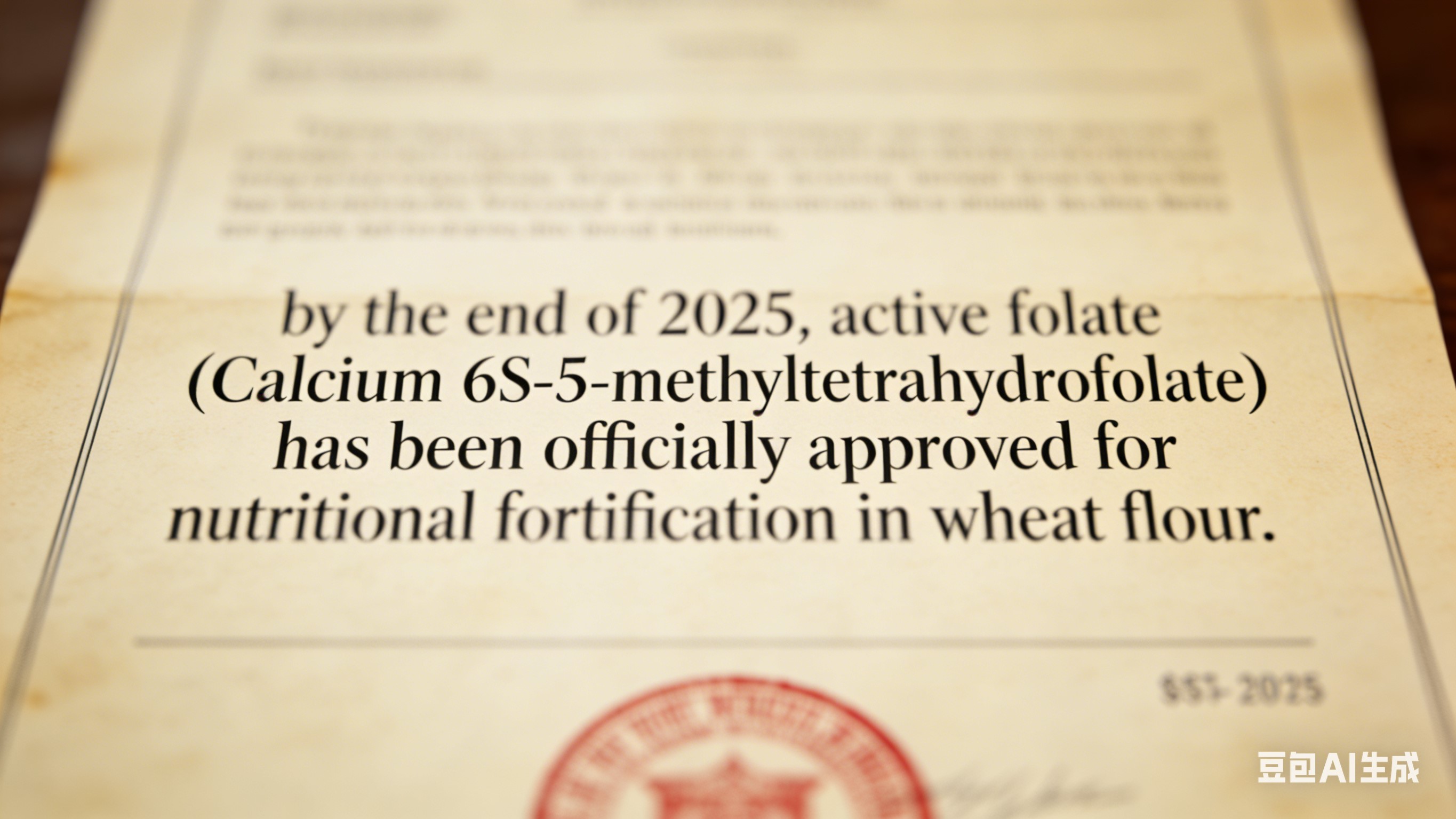
Second, the efficacy barrier. Even if folic acid solves the problem of high-temperature stability, it cannot bypass the inherent metabolic deficiency of Chinese people. 78.4% of the population in China has MTHFR gene polymorphism, which makes them unable to efficiently convert folic acid. The supplement cannot be absorbed by the body, leaving such products ineffective and lacking core competitiveness.
As a naturalization folate, Magnafolate® exists in an active form that the human body can utilize directly. It requires no liver metabolism and can be absorbed immediately after intake. It perfectly matches the genetic characteristics of Chinese people, truly achieving easy absorption, effective utilization, and visible results.
Meanwhile, the patented unique C-crystal form of Magnafolate® features core advantages of high temperature resistance and processing stability. It maintains high activity throughout the entire process of flour milling, steaming, boiling and baking. Combined with mature technological optimization, every bite of staple food delivers precise active folate supplementation — enabling effortless folate intake with daily meals, with zero waste in every mouthful.

Authorized Partial Patent Numbers: CN201410280541.4, US9150982, EP2805952,KR10-1694710, JP6166736, CA2861891, IN342588
References:
[1] BAILEY S W, AYLING J E. The pharmacokinetic advantage of 5-methyltetrahydrofolate for minimization of the risk for birth defects [J]. Scientific Reports, 2018, 8: 4096. DOI:10.1038/s41598-018-22191-2.
[2] YANG B, LIU Y, LI Y, et al. Geographical Distribution of MTHFR C677T, A1298C and MTRR A66G Gene Polymorphisms in China: Findings from 15357 Adults of Han Nationality [J]. PLoS ONE, 2013, 8 (3): e57917. DOI:10.1371/journal.pone.0057917.
[3] Lian Zenglin, Liu Kang, Gu Jinhua, et al. Biological Characteristics and Applications of Folic Acid and 5-Methyltetrahydrofolate[J]. China Food Additives, 2022(2): 1-7.
[4] Xing Dong, Zhang Chuanjun. Feasibility Study from Flour Fortification to Staple Food Nutrient Fortification[J]. Grain Processing, 2009, 34(4): 31-32.
[5] Wang Haibin, Ding Wenping, Li Qinglong. Implementing the National Standard for Nutritionally Fortified Wheat Flour to Promote the Great Development of China's Flour Industry[J]. Grain Processing, 2008, 33(3): 18-20.
[6] Yang Xiaoguang, Huo Junsheng. International Experience of Flour Fortification and Its Promotion in China[J]. Journal of Hygiene Research, 2003, 32(Suppl.): 8-12.
[7] Xie Jie, Li Yan. Problems and Countermeasures in the Promotion of Nutritionally Fortified Flour in China[J]. Grain Circulation Technology, 2008(5): 39-41, 45.
[8] Li Shuguo, Dong Zhenjun, Li Xuemei, et al. Research on the Current Situation and Key Technologies of Nutritionally Fortified Flour in China[J]. Milling Industry, 2005(10): 6-8.
[9] Wang Bo, Huo Junsheng, Sun Jing, et al. Analysis on Nutrient Fortification Strategies of Flour in China[J]. Journal of Hygiene Research, 2008, 37(Suppl.): 10-13.


 Online Service
