
 Español
 Português
  русский
  Français
  日本語
日本語  Deutsch
  tiếng Việt
  Italiano
  Nederlands
  ภาษาไทย
  Polski
  한국어
한국어  Svenska
  magyar
  Malay
Malay  বাংলা ভাষার
  Dansk
Dansk  Suomi
Suomi  हिन्दी
  Pilipino
  Türkçe
  Gaeilge
  العربية
  Indonesia
  Norsk
Norsk  تمل
تمل  český
český  ελληνικά
  український
  Javanese
  فارسی
فارسی  தமிழ்
தமிழ்  తెలుగు
  नेपाली
  Burmese
  български
  ລາວ
ລາວ  Latine
  Қазақша
  Euskal
  Azərbaycan
  Slovenský jazyk
  Македонски
  Lietuvos
  Eesti Keel
  Română
  Slovenski
  मराठी
मराठी  Srpski језик


You take folic acid consistently, maintain a regular routine, and have completed all recommended tests. Some even undergo IVF two or three times, spending over 100,000 yuan and enduring hundreds of injections—only to face repeated failure.

A few days ago, I dined with a friend who works as a reproductive medicine specialist. We discussed common cases in her clinic. She said one of the most frequent questions couples ask is:
“I’ve been taking folic acid regularly, so why can’t I get pregnant, or why do I miscarry shortly after conception?”
As she spoke, a nearby couple was scrolling through their phones—likely searching for the same concern.
This moment inspired me to delve deeper into the topic of folic acid.
Do You Think Folate Is Just “One Pill a Day for TTC”?
Many people hold a simplistic view: take folate while trying to conceive and during early pregnancy, primarily to prevent fetal neural tube defects.
This is true—but it is only a small part of its role.
A 2010 review published in Nutrition Reviews (Impact Factor: 6.1) synthesized research on folate-mediated one-carbon metabolism and female fertility. After reading it, I realized folate is far more complex than “one pill a day.”
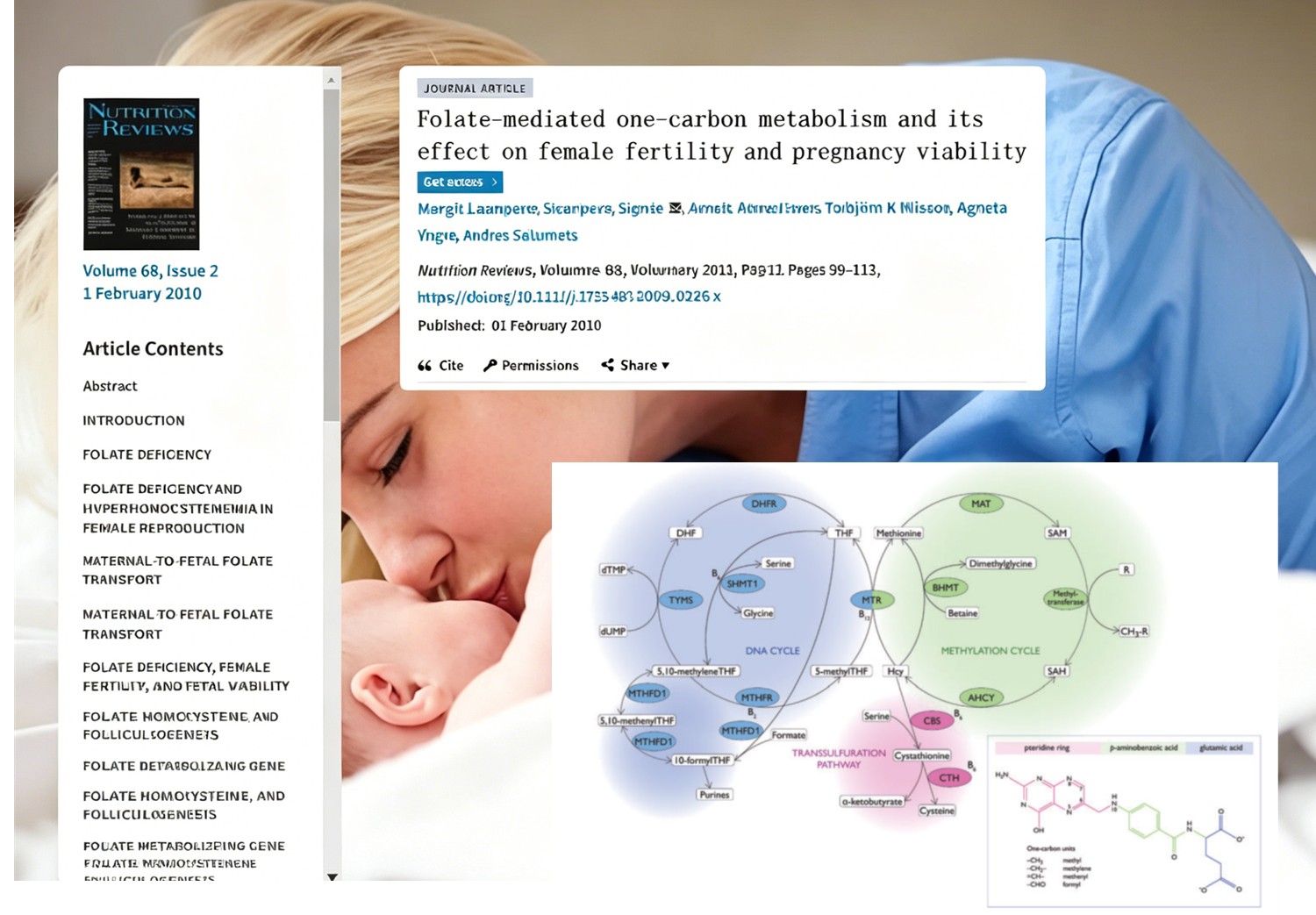
Folate is integral to a physiological process called one-carbon metabolism. It supports cellular energy production, DNA synthesis and repair, and regulates DNA methylation.
In plain terms:
- Impaired DNA synthesis and repair → higher risk of genetic abnormalities in eggs → abnormal embryonic development.
- Disrupted methylation → dysregulated gene function → compromised embryo implantation and early development.
You may also be familiar with homocysteine (Hcy). Low folate levels elevate blood Hcy, which in turn increases the risk of pregnancy complications.
So you might wonder: “I’ll just keep taking folic acid, right?”
But here’s the critical point: Can your body actually utilize the folic acid you’re taking?
The Hidden Genetic Factor Most People Overlook
This is the most crucial part.
MTHFR gene—a term you may have encountered in TTC communities. Its full name is methylenetetrahydrofolate reductase, a key enzyme in folate metabolism.
This gene is prone to polymorphisms (variants), and the prevalence is surprisingly high. Studies indicate nearly three-quarters of the Chinese population carry MTHFR gene variants.
What Happens If the Gene Is Altered?
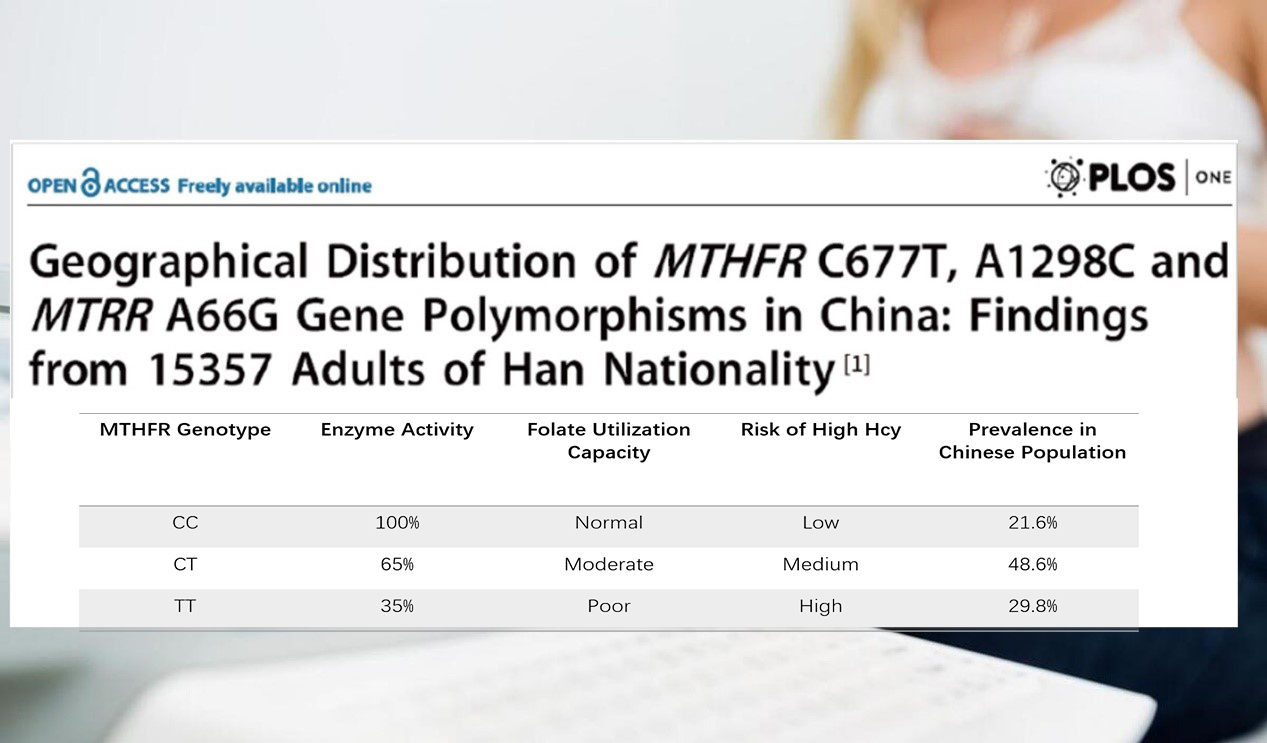
It reduces folate metabolic efficiency. Ordinary folic acid must be converted into active folate (5-MTHF) by the MTHFR enzyme before it can be utilized by the body. If the enzyme’s activity is impaired due to genetic variants, a significant portion of the folic acid you take remains unconverted.
The review highlighted key findings:
- MTHFR gene variants → reduced ovarian reserve.
- Poorer ovarian response to ovulation-inducing medications → lower live birth rates following IVF.
- Elevated follicular fluid Hcy → reduced egg maturation and poorer embryo quality.
- Higher prevalence of the MTHFR 677TT homozygous variant in women with repeated implantation failure.
- Higher frequency of the MTHFR C677T homozygous variant in women with recurrent pregnancy loss.
Poor egg quality → poor embryo quality → implantation failure.
This explains why many women take folic acid regularly yet fail to benefit from it. Folate metabolism plays a far more profound role in fertility than most people realize.
Active Folate: A Potential Alternative
So what can you do?
Do not adjust supplements on your own. Always consult a healthcare provider before modifying nutritional intake.
If you experience any of the following, discuss folate metabolism testing with your doctor:
- Elevated homocysteine (Hcy) levels.
- Confirmed MTHFR gene variants.
- Repeated IVF failure or recurrent miscarriage.
- Unexplained infertility.
If folate metabolism dysfunction is confirmed, your doctor may recommend replacing synthetic folic acid with active folate.
What Is Active Folate?
It is the pre-converted, bioavailable form of folate (5-MTHF), requiring no further processing by the MTHFR enzyme. It bypasses genetic-related metabolic inefficiencies and can be directly utilized by the body.
Important Note on Active Folate
5-MTHF is inherently unstable and easily degraded by light, heat, and oxidation. Poor manufacturing processes can lead to rapid loss of potency over time.
Stability is a critical consideration when selecting an active folate supplement.
For example, Magnafolate (C-crystal form) utilizes patented stabilization technology. Public data confirms it remains stable at room temperature for over three years—a significant advantage for individuals taking it long-term while trying to conceive.

Final Thoughts
Folate is important, but it is only one contributing factor to fertility.
Infertility, recurrent miscarriage, and IVF failure stem from complex, multifactorial causes. Folate metabolism may be one piece of the puzzle, but it is not the sole solution.
Attend regular checkups and always follow the guidance of qualified medical professionals.
References
[1] Folate-mediated one-carbon metabolism and its effect on female fertility and pregnancy viability. Nutrition Reviews, 2010 Feb;68(2):119-35.
[2] Lian Z, Liu K, Gu J, et al. Biological characteristics and applications of folic acid and 5-methyltetrahydrofolate. China Food Additives, 2022(2).
[3] Yang B, Liu Y, Li Y, et al. Geographical Distribution of MTHFR C677T, A1298C and MTRR A66G Gene Polymorphisms in China: Findings from 15,357 Adults of Han Nationality. PLOS ONE, 2013, 8(3): e57917.
Disclaimer
Magnafolate is a supplier of active folate raw materials and does not provide direct medical advice to consumers. Decisions regarding supplementation should be made under the guidance of a qualified healthcare professional. This content is for educational purposes only and does not constitute medical advice. This product is a food raw material and cannot replace pharmaceutical drugs.


 Online Service
