
 Español
 Português
  русский
  Français
  日本語
日本語  Deutsch
  tiếng Việt
  Italiano
  Nederlands
  ภาษาไทย
  Polski
  한국어
한국어  Svenska
  magyar
  Malay
Malay  বাংলা ভাষার
  Dansk
Dansk  Suomi
Suomi  हिन्दी
  Pilipino
  Türkçe
  Gaeilge
  العربية
  Indonesia
  Norsk
Norsk  تمل
تمل  český
český  ελληνικά
  український
  Javanese
  فارسی
فارسی  தமிழ்
தமிழ்  తెలుగు
  नेपाली
  Burmese
  български
  ລາວ
ລາວ  Latine
  Қазақша
  Euskal
  Azərbaycan
  Slovenský jazyk
  Македонски
  Lietuvos
  Eesti Keel
  Română
  Slovenski
  मराठी
मराठी  Srpski језик


Sarah is 34 this year. She spent three years trying to conceive and went through three pregnancy losses. To find out why, she had every reproductive test she could think of. The results were all clean. Nothing abnormal showed up. She took even the most ordinary folic acid tablets with almost religious discipline, never missing a day. Then today, the doctor looked through her thick stack of records and said, “Why don’t we check a metabolic gene?”
Sarah Shen was holding the report that had just been printed out, staring at the words “MTHFR: TT genotype” in a daze. She had no idea what that string of letters meant. But she understood the doctor’s explanation.
It turned out that for all three years, the folic acid she swallowed on schedule every day had basically gone to waste. The direction was wrong from the start. What’s especially frustrating is that this kind of metabolic assessment, which can directly affect the outcome, is often skipped in routine preconception checkups.
Why taking enough folic acid still may not be enough
Ordinary folic acid cannot go straight into the biochemical reactions inside cells. It has to go through a series of conversions first. The key step is the one handled by MTHFR, short for methylenetetrahydrofolate reductase. When the MTHFR gene undergoes a polymorphic change, the activity of the reductase it encodes drops significantly, and the folate cycle gets stuck at the final step. Think of it like an assembly line in a factory: ordinary folic acid is the raw material, MTHFR is the core processing machine, and active folate is the finished product leaving the line. The TT genotype is like the machine’s output falling off a cliff. Raw material piles up in the warehouse, but finished product doesn’t come out. That’s the metabolic bottleneck.
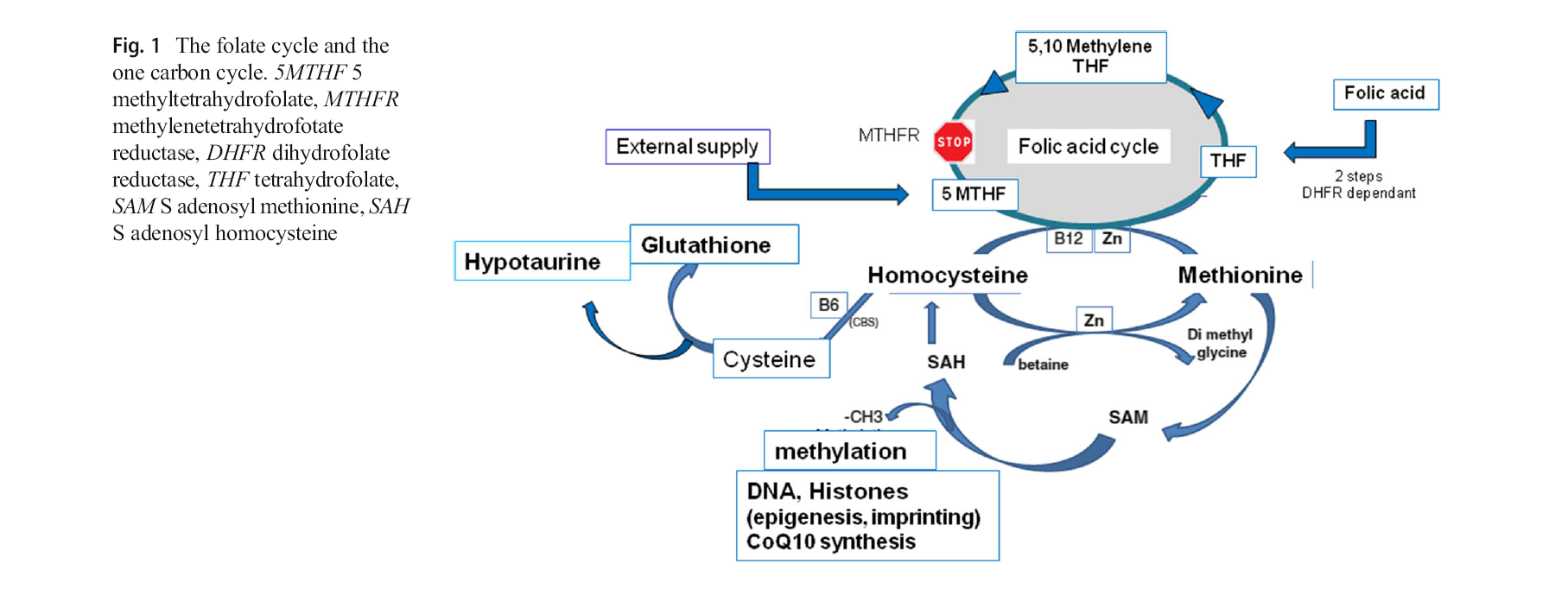
In China, the MTHFR TT genotype is not rare. A population distribution study by Yang et al. (2013) found that people with the TT or CT genotype made up 78.4% of the sample. Once this gene changes, ordinary folic acid needs to be processed by MTHFR before it can become the active form, and the processing efficiency in TT carriers is only about one-third of normal. The result is folic acid building up in the body, while only a small amount of active folate is actually available. Unmetabolized Folic acid can also accumulate, and homocysteine (Hcy) starts to rise.
How gene polymorphisms affect real fertility outcomes
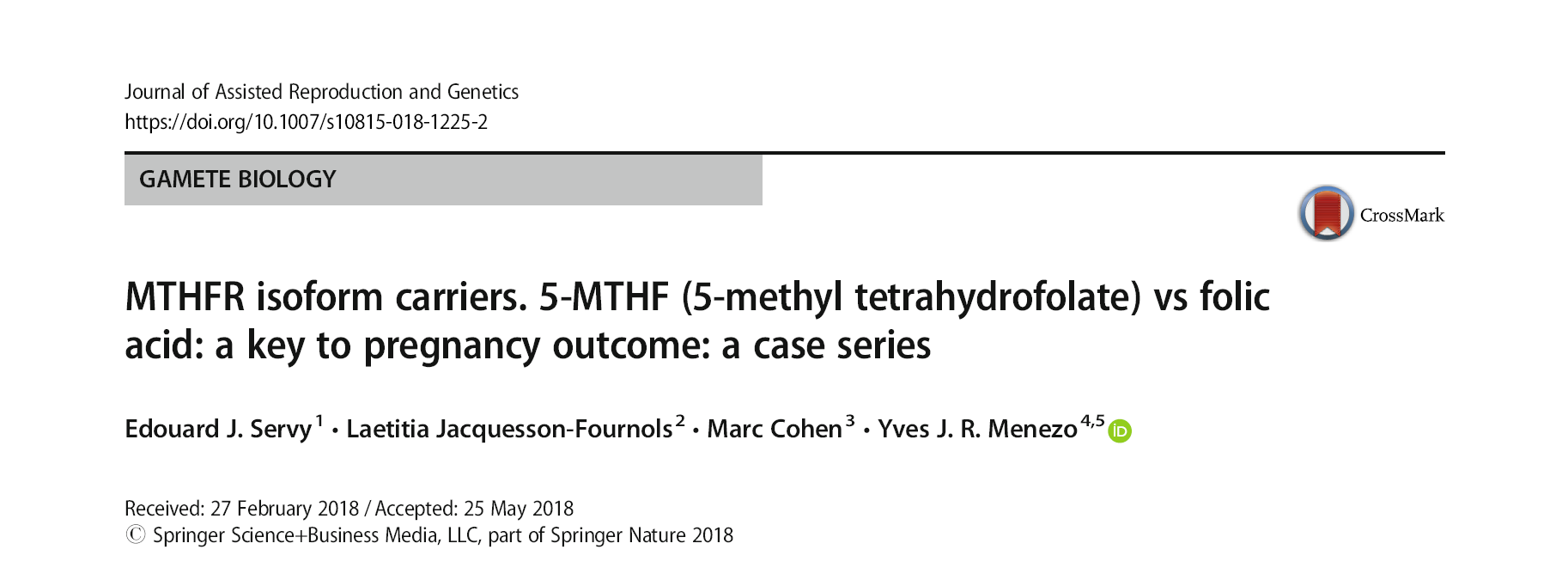
Hcy is a metabolic byproduct with vascular toxicity. When its level rises, it damages the vascular endothelium and affects the early development of placental microvessels. A clinical observation involving 30 couples with MTHFR gene polymorphisms brought this problem into focus. These patients had previously taken 5 mg of ordinary folic acid every day, far above the usual standard, yet they still experienced repeated miscarriages, abnormal sperm parameters, or failed assisted reproduction. Some of the couples had already gone through multiple pregnancy losses. It’s hard to explain why such a high dose did absolutely nothing if you stick to the usual logic. The real problem was that the body could not convert it into a usable active form.
A zebrafish embryo development model showed a similar metabolic burden: exposure to high doses of ordinary folic acid led to pericardial edema and abnormal vascular development in embryos (Lian et al., 2022). At the very least, this suggests that once conversion is already blocked, blindly increasing the dose of ordinary folic acid may not help.
A clinical observation that bypasses the bottleneck
When there is an inherent conversion barrier like this, direct active folate supplementation becomes the obvious next step. The patients in the study above changed strategy: they stopped ordinary folic acid and switched to 800 micrograms of 5-methyltetrahydrofolate per day, the active form of folate in the body. Four months later, 29 couples completed follow-up, and 26 achieved pregnancy, 13 naturally and 13 through assisted reproduction. The success rate among those who completed follow-up was 90.3% (Servy et al., 2018).
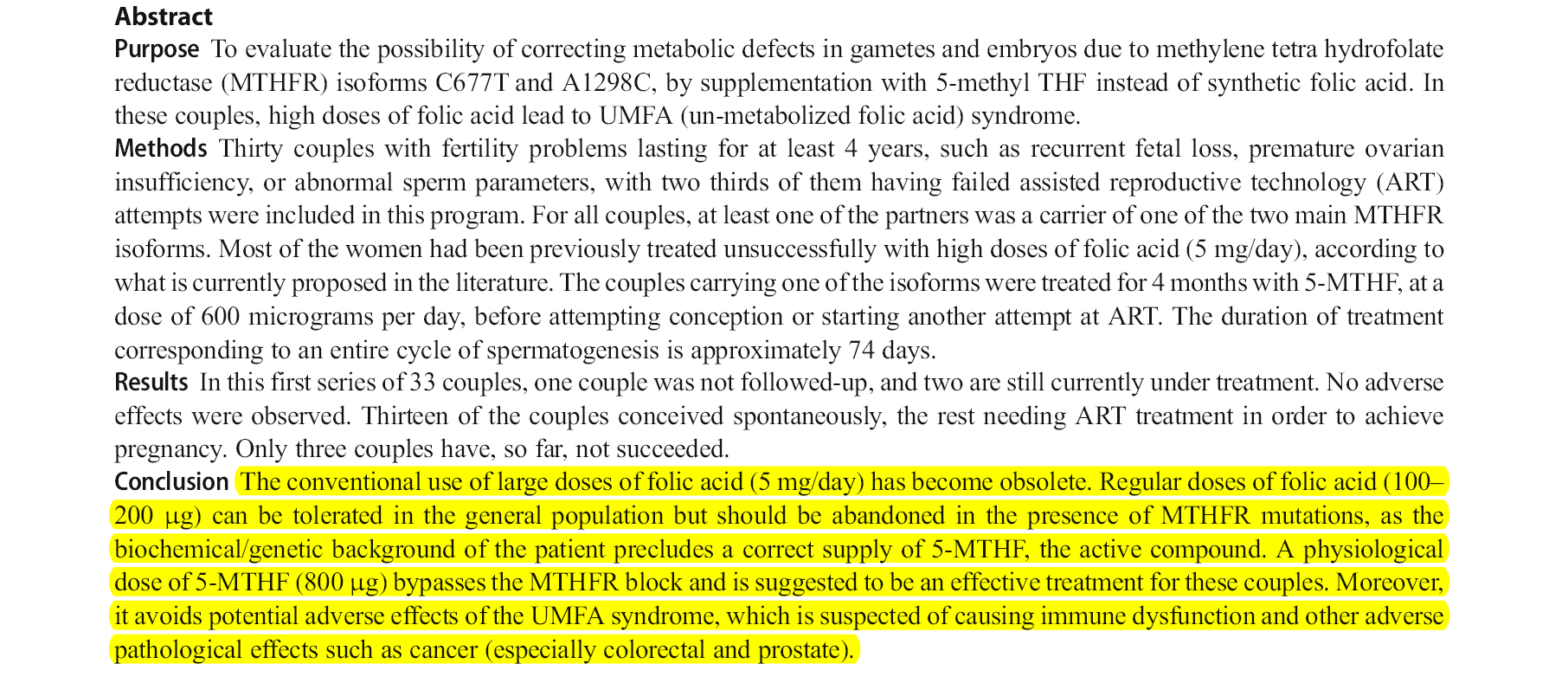
Directly supplementing active folate is, in effect, a way to bypass the MTHFR step and quickly raise the active folate level needed by the mother and the early embryo. For couples with gene polymorphisms, it is a path worth considering when trying to improve fertility outcomes.
How to decide whether to switch to active folate
When you get the test report, start with the genotype. If it is a homozygous mutation (TT) or a heterozygous mutation (CT), that suggests there is a congenital bottleneck in conversion, and routine supplementation may not meet the real need. Then look at homocysteine levels: if they are elevated, it means methylation metabolism has already been materially affected, and the vascular endothelium may be under silent stress. Put these two results together, then decide whether ordinary folic acid should be replaced with the active form.
Among active folate raw materials, Magnafolate is one option: it directly provides 6S-5-methyltetrahydrofolate calcium, the active form, without needing MTHFR conversion, and it can participate directly in the body’s methylation cycle.
Absorption differences from crystal structure
Beyond the active form itself, the physical structure of the raw material also affects how it behaves in the body. That brings us to crystal form. Research shows that the C crystal form of 6S-5-methyltetrahydrofolate calcium has a longer mean residence time in the body, up to 3.7 hours, and releases more steadily. In plain terms, that means better absorption and a longer effective blood concentration, which helps improve both efficiency and consistency of supplementation (Lian et al., 2021). Magnafolate uses this C crystal form process. It remains stable under specific temperature and processing conditions and has passed the world’s first Naturalization folate certification.
Safety with long-term use
Preconception is usually a long haul, so the supplementation plan has to be safe enough. Impurity control is a key part of evaluating the long-term safety of active folate. Studies have found that certain oxidative byproduct impurities in active folate, such as JK12A, can affect zebrafish embryo growth, heart rate, and survival in a dose-dependent manner. In production, the C crystal form of Magnafolate keeps strict control over this kind of impurity, and the JK12A impurity content is only one-tenth of the USP pharmacopoeia standard in the United States.
Sarah Shen switched to active folate. In her fourth attempt to conceive, the ultrasound at 8 weeks showed a fetal heartbeat. For some people, conversion has an inherent bottleneck. Direct active folate supplementation is one way around it. When reviewing reproductive test results, beyond hormones and the endometrium, the often-overlooked MTHFR genotype is frequently the key factor that determines the direction of folate supplementation.
________________________________________
Folate Check Card
1. Check the genotype: MTHFR typing (CT/TT suggests a conversion bottleneck)
2. Check the markers: Hcy + serum/red blood cell folate + vitamin B12 (these reflect the current state; genes cannot replace biochemical markers)
3. Check the form: ordinary folic acid needs conversion -> 6S-5-methyltetrahydrofolate, the active form (bypasses the metabolic bottleneck)
4. Check the raw material: 6S configuration + C crystal form stability + impurity control + Naturalization folate certification
One sentence: genes show the background, the active form shows the path, the raw material shows the certification.
________________________________________
References
[1] Cheng et al. Nutrition Journal, 2022, 21:20. Evaluation of the association between maternal folic acid supplementation and the risk of congenital heart disease: a systematic review and meta-analysis. https://doi.org/10.1186/s12937-022-00772-2
[2] Yang B, Liu Y, Li Y, et al. Geographical Distribution of MTHFR C677T, A1298C and MTRR A66G Gene Polymorphisms in China: Findings from 15357 Adults of Han Nationality[J]. PLoS ONE, 2013, 8(3): e57917. doi:10.1371/journal.pone.0057917
[3] Lian Zenglin, Liu Kang, Gu Jinhua, Cheng Yongzhi, et al. Biological Characteristics and Applications of Folate and 5-Methyltetrahydrofolate. China Food Additives, 2022, Issue 2.
[4] Servy EJ, Jacquesson-Fournols L, Cohen M, et al. MTHFR isoform carriers. 5-MTHF (5-methyltetrahydrofolate) vs folic acid: a key to pregnancy outcome: a case series[J]. Journal of Assisted Reproduction and Genetics, 2018. https://doi.org/10.1007/s10815-018-1225-2
[5] Lian Z, Wu Z, Gu R, et al. Evaluation of Cardiovascular Toxicity of Folic Acid and 6S-5-Methyltetrahydrofolate-Calcium in Early Embryonic Development. Cells, 2022, 11, 3946. https://doi.org/10.3390/cells11243946
[6] Lian Z, Chen H, Liu K, et al. Improved Stability of a Stable Crystal Form C of 6S-5-Methyltetrahydrofolate Calcium Salt, Method Development and Validation of an LC-MS/MS Method for Rat Pharmacokinetic Comparison[J]. Molecules, 2021, 26(19):6011. https://doi.org/10.3390/molecules26196011
________________________________________
[Magnafolate® supplies only 6S-5-methyltetrahydrofolate calcium active folate raw material and does not directly provide consumers with diagnostic or treatment advice, nor does it constitute any diagnosis or treatment plan for any disease. Any folate supplementation or nutritional intervention decision must be made under the guidance of a professional physician or registered dietitian, based on individual genotyping, biochemical markers, and medical history.
The person mentioned in this article, Sarah, is a fictional case used only to help readers understand the scientific mechanism. Case details and data are within commonly observed clinical reference ranges and do not refer to any specific individual.
The causal claims in this article are strictly limited to conclusions already proven in the cited literature. The case series is included only as an observational clue and does not replace randomized controlled evidence or individualized diagnosis and treatment. This article does not constitute any commitment regarding the efficacy, safety, or suitability of Magnafolate® or any other product. Raw material information is for reference only; formulations and final products must separately complete compliance evaluation in accordance with applicable laws and regulations.]


 Online Service
