
 Español
 Português
  русский
  Français
  日本語
日本語  Deutsch
  tiếng Việt
  Italiano
  Nederlands
  ภาษาไทย
  Polski
  한국어
한국어  Svenska
  magyar
  Malay
Malay  বাংলা ভাষার
  Dansk
Dansk  Suomi
Suomi  हिन्दी
  Pilipino
  Türkçe
  Gaeilge
  العربية
  Indonesia
  Norsk
Norsk  تمل
تمل  český
český  ελληνικά
  український
  Javanese
  فارسی
فارسی  தமிழ்
தமிழ்  తెలుగు
  नेपाली
  Burmese
  български
  ລາວ
ລາວ  Latine
  Қазақша
  Euskal
  Azərbaycan
  Slovenský jazyk
  Македонски
  Lietuvos
  Eesti Keel
  Română
  Slovenski
  मराठी
मराठी  Srpski језик


Sarah Lin is 34 and has been trying to conceive for nearly three years. During that time, she has experienced two early missed miscarriages. The first happened at eight weeks. On the ultrasound, the embryonic bud should have continued developing. Instead, it stopped. The second was at nine weeks. She had seen a fetal heartbeat. That day, she photographed the ultrasound and sent it to her husband, zooming in again and again on that tiny flicker. At the follow-up appointment, it was gone. She kept slipping test reports into a folder. The folder grew thicker. The answers did not. Throughout her attempts to conceive, she never missed a day of folate supplementation. When her phone alarm went off, she took it. Once, rushing out the door, she realized at the elevator that she had forgotten the bottle and went back for it. Her thyroid function, blood glucose, and coagulation tests showed no obvious abnormalities. Both partners’ chromosomal karyotypes were also within the reference range. Yet the more “normal” the reports looked, the less certain she felt.
Later, her reproductive specialist suggested additional testing for homocysteine and folate-metabolism-related genes. When the results came out, she sat on a plastic chair in the hospital corridor, report spread across her knees, reading it over and over. Homocysteine: 14.6 μmol/L. MTHFR C677T genotype: CT. Of course, the report did not say, “This is why the pregnancy stopped developing.” No single report can put a definitive stamp on something like that. Still, one question kept circling in her mind. She had clearly been taking folate. Had her body actually been able to use it?
Taking Folate Does Not Always Mean the Metabolic Pathway Is Functioning Smoothly
In August 2024, *Technology and Health Care* published a study examining the relationship between different forms of folate supplementation and pregnancy outcomes. The researchers did not simply ask whether participants had taken folate.

They looked at the full picture: prior adverse pregnancy history, elevated homocysteine levels, and polymorphisms at sites such as MTHFR C677T and A1298C. Folate supplementation sounds simple enough. One tablet a day. A daily reminder. Perhaps even a decent folate level on a routine blood test. If that were all there was to it, far fewer people would be standing outside clinic rooms, holding a stack of test reports and waiting for an appointment. The study compared 5-Methyltetrahydropteroic acid with synthetic folic acid in people with elevated homocysteine, a history of adverse pregnancy outcomes, and related risk factors.
The findings showed that 5-Methyltetrahydropteroic acid could reduce serum homocysteine levels. In this study, the incidence of adverse pregnancy outcomes was lower among those using this form of folate than in the synthetic folic acid group.
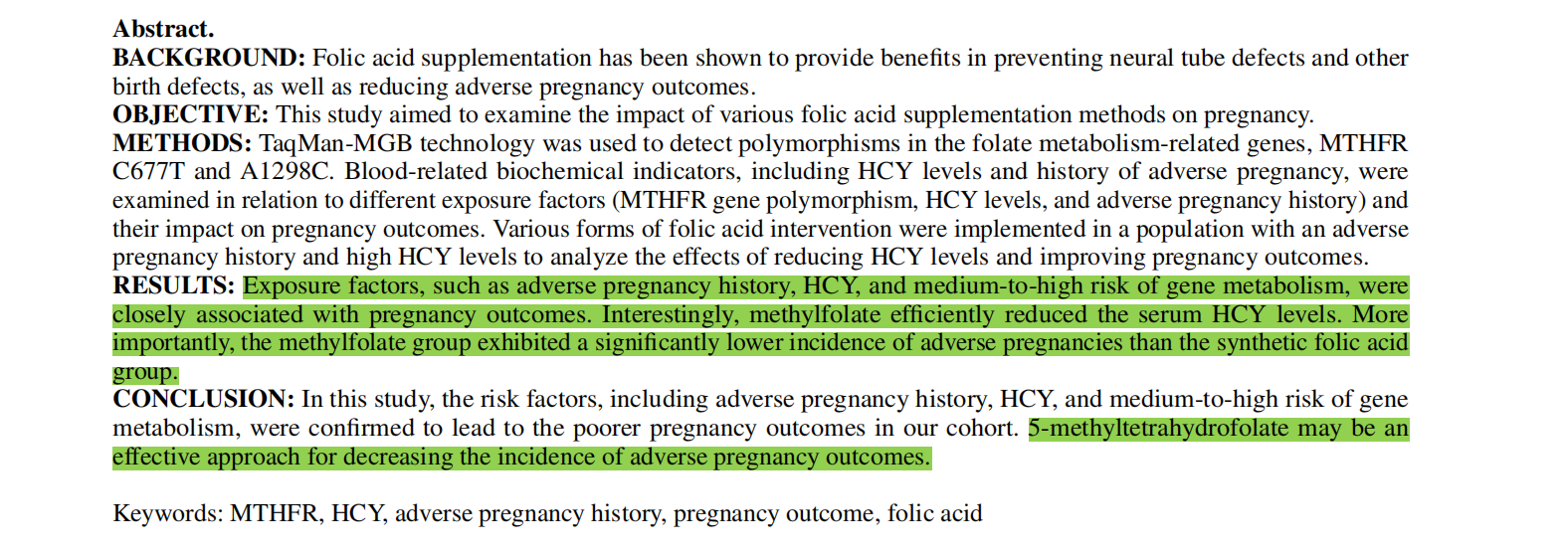
That said, the study did not reduce adverse pregnancy outcomes to a single cause. And it should not. This is not a multiple-choice question. Previous pregnancy outcomes, Hcy levels, and genetic metabolic risks are often intertwined. Untangling them means looking at each factor in turn.


Homocysteine Is a Signal Light in Metabolism
Homocysteine is often abbreviated as Hcy. It is part of the one-carbon metabolic cycle and requires nutrients such as folate, vitamin B12, and vitamin B6 to support its conversion. When any part of that process falls behind, Hcy may rise.
For people trying to conceive, Hcy is not a verdict on pregnancy outcomes. It is more like a warning light on the dashboard. It does not necessarily mean the engine has failed, but it does mean it may be time to pull over and look at where the problem could be occurring. The enzyme encoded by the MTHFR gene helps convert dietary folate into an active form the body can use. Variants at sites such as MTHFR C677T and A1298C may reduce conversion efficiency in some individuals.
These genetic polymorphisms are not uncommon among the Han Chinese population. After synthetic folic acid enters the body, it still needs to go through a series of conversions before it can enter subsequent metabolic pathways. By comparison, 6S-5-Methyltetrahydropteroic acid is an active form that the body can use directly and is relatively less dependent on the MTHFR conversion step. But finding a genetic variant does not mean someone will inevitably experience an adverse pregnancy outcome. There is no need to panic. Genotype is only one piece of the picture. Folate status, Hcy levels, B-vitamin status, age, and underlying health conditions all need to be considered together. Fixating on a single number or one genetic site often creates more anxiety without necessarily pointing to the real issue.
What Matters Is the Form and Status of Folate
For people with a history of adverse pregnancy outcomes, elevated Hcy, or indications of moderate-to-high metabolic risk, folate supplementation should not focus on dosage alone. There are other questions to ask. Is the supplement in an active form that can participate directly in metabolism?
Is the raw material in the 6S configuration? 6S-5-Methyltetrahydropteroic acid is a naturally occurring configuration in the human body that can participate in metabolic processes. There is another issue that is easy to overlook: how stable is the product during manufacturing and storage?
Active folate is relatively sensitive to light, heat, and oxidation. A product may contain the stated amount when purchased, but that does not necessarily indicate how much active ingredient remains after storage and by the time it is taken.
Then there is the question of whether the supplementation plan has been adjusted based on test results. Elevated Hcy is not only about folate. Vitamin B12 and B6 status should also be assessed by qualified professionals. Seeing a high result and immediately filling an online shopping cart with several bottles of high-dose supplements late at night may bring temporary peace of mind. It does not necessarily solve the underlying problem. At the raw-material level, Magnafolate provides one example for comparison.
It is currently the only 6S-5-Methyltetrahydropteroic acid calcium product to receive Zhongwei’an Naturalization folate certification. It is an active form that the body can use directly and is manufactured using patented C-crystal technology.
Research by Lian Zenglin and colleagues indicates that the C-crystal form offers corresponding advantages in impurity control, stability, and bioavailability.[3] For those who pay attention to the form, configuration, and stability of active folate, this type of raw-material information can at least serve as a point of reference when evaluating products. Still, this needs to be said clearly. Such information can help people ask more specific questions. It cannot replace testing, and it certainly cannot replace a clinician’s assessment of the whole situation.
Switching Folate Forms Does Not Mean Skipping a Full Evaluation
Later, Sarah returned to the clinic with her genetic test results, Hcy report, and records from her previous pregnancies. Her doctor did not simply tell her to increase the dose. Instead, they reassessed the form of folate, her B-vitamin status, and the schedule for follow-up testing.
After her supplementation approach was adjusted, she began monitoring her Hcy according to plan. She also reorganized her sleep, diet, and follow-up appointments around a more structured schedule. She did not treat the change as an answer that would work overnight.
After two losses, she understood that trying to conceive is not something that can be rushed. Sometimes, the issue with folate is not whether it has been taken. It is whether the form is appropriate, whether the metabolic pathway is functioning effectively, and whether relevant risks have been identified in time.
If you have experienced recurrent missed miscarriages, biochemical pregnancies, repeated embryo implantation failure, or persistently elevated Hcy, it may be more helpful to bring your complete test records to a reproductive medicine or nutrition clinic for a thorough assessment than to quietly switch products or repeatedly increase the dose on your own.
Clarifying what needs to be tested is the first step.
Under the guidance of a doctor or nutritionist, changing from synthetic folic acid, which may not always be readily utilized after supplementation, to an active folate the body can use directly, such as a formulation made with Magnafolate, is one option worth discussing. It cannot replace a comprehensive evaluation. But alongside systematic assessment, it may form part of a more complete preconception care plan.
References
[1] Influence of different forms of folic acid supplementation on pregnancy outcomes under various exposure factors[J]. *Technology and Health Care*, 2024.
[2] Yang B, Liu Y, Li Y, et al. Geographical Distribution of MTHFR C677T, A1298C and MTRR A66G Gene Polymorphisms in China: Findings from 15357 Adults of Han Nationality[J]. *PLoS ONE*, 2013, 8(3): e57917. doi:10.1371/journal.pone.0057917.
[3] Lian Zenglin, Liu Kang, Gu Jinhua, Cheng Yongzhi, et al. Biological Characteristics and Applications of Folate and 5-Methyltetrahydropteroic acid. *China Food Additives*, Issue 2, 2022.
Relevant Authorized Patents
Related to C-crystal technology; granted in the following countries and regions: CN201410280541.4 (China), US9150982 (United States), EP2805952 (Europe), KR10-1694710 (South Korea), JP6166736 (Japan), CA2861891 (Canada), and IN342588 (India).
Relevant Certification
Zhongwei’an Naturalization folate Certification, Certificate No. CHS173B20260019.
Risk Notice: Magnafolate® is supplied solely as an active folate raw material, specifically 6S-5-Methyltetrahydropteroic acid calcium. It does not provide direct diagnostic or treatment advice to consumers. Any decision regarding folate supplementation should be made under the guidance of a qualified physician or nutritionist. The individual described in this article is fictional and is used solely to help readers understand the scientific mechanisms involved. The details and data in the story fall within ranges commonly encountered in clinical practice. Any causal interpretation in this article is strictly limited to conclusions supported by the cited literature and does not constitute a promise of efficacy for any product.


 Online Service
