
 Español
 Português
  русский
  Français
  日本語
日本語  Deutsch
  tiếng Việt
  Italiano
  Nederlands
  ภาษาไทย
  Polski
  한국어
한국어  Svenska
  magyar
  Malay
Malay  বাংলা ভাষার
  Dansk
Dansk  Suomi
Suomi  हिन्दी
  Pilipino
  Türkçe
  Gaeilge
  العربية
  Indonesia
  Norsk
Norsk  تمل
تمل  český
český  ελληνικά
  український
  Javanese
  فارسی
فارسی  தமிழ்
தமிழ்  తెలుగు
  नेपाली
  Burmese
  български
  ລາວ
ລາວ  Latine
  Қазақша
  Euskal
  Azərbaycan
  Slovenský jazyk
  Македонски
  Lietuvos
  Eesti Keel
  Română
  Slovenski
  मराठी
मराठी  Srpski језик


Sarah is 31 this year. She had experienced an early biochemical pregnancy once before. Some time has passed, but when it comes to trying to conceive, she still finds it hard to fully relax. For the three months before trying again, she took folate every day according to a standard plan. Whenever her phone alarm went off, she reached for the supplement. She rarely missed a dose. So at her preconception checkup, when she saw the number on the report, she sat outside the consultation room for a long while without moving.
Homocysteine: 12.5 μmol/L.
“I’ve been taking folate every day,” she said, handing over the report. Her voice was tight. “Why is it still high?”
The doctor looked down at the test results first. “Try not to worry yet. A level of 12.5 μmol/L needs to be interpreted alongside other indicators, and we’ll also need follow-up testing.”
“Does that mean I haven’t been taking enough?”
“The amount you take is only one part of the picture,” the doctor said. “We also need to know whether your body can use the folate afterward. Vitamin B12, vitamin B6, kidney function, thyroid function, dietary habits, and medications can all affect this result.”
Sarah held the edge of the report and paused. “Could it be related to my biochemical pregnancy?”
“Let’s first clarify what we can test,” the doctor said, turning the report back toward her. “A report is meant to point us in a direction, not scare us.”
When preparing for pregnancy, many people focus most on whether they have taken their supplements and whether they have missed any doses. Those things matter, of course. But once folate enters the body, the job is not done. It still needs to be absorbed, converted, and utilized. Metabolism varies from person to person, so the same supplementation approach may lead to different lab results.
▍What Can We Learn from Data on 816 Pregnant Women?
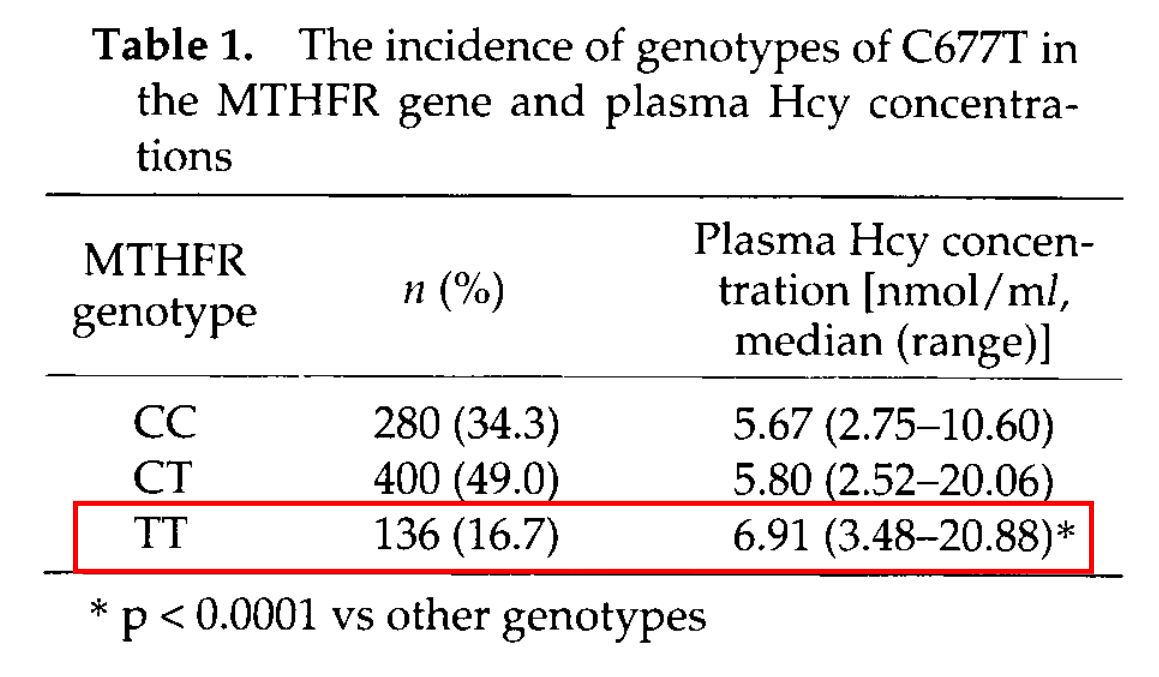
In 2001, The Journal of Obstetrics and Gynaecology Research published a study involving 816 women who were 6 to 12 weeks pregnant. Researchers measured their homocysteine levels and analyzed their MTHFR C677T genotypes. In the study population, 34.3% had the CC genotype, 49.0% had the CT genotype, and 16.7% had the TT genotype.

When researchers examined genotype alongside plasma homocysteine data, they found that women with the TT genotype had a median plasma homocysteine level of 6.91 nmol/mL, higher than 5.67 nmol/mL in the CC group and 5.80 nmol/mL in the CT group. The differences between groups were statistically significant.
Sarah stared at the numbers. “So does having the TT genotype mean something will definitely go wrong?”
“No,” the doctor said. “A genotype may indicate possible metabolic differences, but pregnancy outcomes cannot be predicted based on that one factor alone.”
The study included complete pregnancy outcome data for 749 participants. Among the 35 women in the high-homocysteine group, 2 developed severe preeclampsia. Among the 714 women whose homocysteine levels were within the normal range, 5 developed severe preeclampsia. There was also a difference in stillbirth data: 2 out of 35 in the high-homocysteine group, compared with 10 out of 714 in the normal-range group. Still, these figures describe statistical associations. They do not mean that one elevated marker will inevitably lead to a particular outcome.
“What should I pay attention to now?” Sarah asked.
“The key is not to frighten yourself first,” the doctor said. “If homocysteine is elevated, identify the cause before deciding how to supplement.”
▍Why Can Homocysteine Levels Rise?
Homocysteine is an intermediate product of amino acid metabolism. The body can convert it into methionine through the remethylation pathway, or direct it into subsequent metabolism through the transsulfuration pathway. Nutrients including folate, vitamin B12, and vitamin B6 all play a role in these processes. After folic acid enters the body, it must undergo several conversion steps. MTHFR is one of the more important enzymes involved. It helps produce 6S-5-Methyltetrahydropteroic acid, also known as 5-MTHF.
5-MTHF can participate in the remethylation of homocysteine. But it does not do the job alone; vitamin B12 and related enzyme systems are also essential. Sarah asked, “What is the actual difference between the regular folic acid I take and 6S-5-Methyltetrahydropteroic acid?” “Regular folic acid needs to be converted in the body,” the doctor explained. “6S-5-Methyltetrahydropteroic acid is an active form of folate and can bypass the MTHFR step.” “Then should everyone with the TT genotype switch to 6S-5-Methyltetrahydropteroic acid?” The doctor shook her head.
“It is not that simple. The TT genotype is associated with reduced MTHFR activity, but it is not the only possible reason for elevated homocysteine. Vitamin B12 deficiency, inadequate vitamin B6, impaired kidney function, thyroid dysfunction, dietary patterns, smoking, alcohol consumption, and certain medications can all affect the result.” Sarah understood. “So I need to find out what is going on first. I shouldn’t just increase the dose because I think it is not enough?”
“That’s right. Assess first, then decide.” The MTHFR C677T locus has genetic polymorphisms. People with the TT genotype may have lower MTHFR enzyme activity, which may affect the efficiency of 6S-5-Methyltetrahydropteroic acid production in some individuals. If homocysteine is elevated, or if levels remain outside the reference range after routine supplementation, active folate supplementation options may be discussed with a physician or nutrition professional.
▍When Metabolism Hits a Bottleneck, the Form of Supplementation May Need to Change
For women preparing for pregnancy—particularly those with a history of adverse pregnancy outcomes or persistently elevated homocysteine despite routine supplementation—the following questions may be worth discussing with a doctor or nutrition professional. First, consider the metabolic foundation. For example, is there an MTHFR C677T polymorphism? Then review blood markers. Is homocysteine within the reference range? Is repeat monitoring needed? What are the individual’s folate and vitamin B12 status? These factors should be considered together. Finally, adjust the supplementation strategy based on the individual situation. For people with confirmed limitations in conversion, directly supplementing with an active form of 6S-5-Methyltetrahydropteroic acid may be an option worth discussing with a qualified professional. Because 5-MTHF is already active, it does not require conversion through the MTHFR step and can participate in homocysteine remethylation.
Magnafolate may be used as a reference for relevant ingredient information. It is an active folate in the stable Crystal Form C of 6S-5-Methyltetrahydropteroic acid calcium. Research using zebrafish embryo models has suggested that high doses of conventional synthetic folic acid may be associated with abnormal cardiovascular development. Within the same dose range, Magnafolate did not show cardiovascular toxicity or embryonic developmental defects. A toxicological evaluation conducted by the Shanghai Center for Disease Control and Prevention further indicated that Magnafolate met the practical non-toxic classification. Animal studies, however, cannot be directly extrapolated to humans. The form and amount of supplementation should always be based on individual test results and professional guidance. Do not rush to change your plan simply because you come across a single claim. When preparing for pregnancy, taking a steadier approach is often less stressful in the long run.
▍What Did Sarah Do Next?
After completing further testing, Sarah confirmed that she had the MTHFR C677T TT genotype and elevated homocysteine. She did not increase her dosage on her own. Nor did she throw out her entire preconception plan just because of one genetic report.
“What should I do first?” she asked.
The doctor wrote down the follow-up tests in her chart. “Recheck your folate, vitamin B12, and homocysteine as scheduled. We can also adjust your supplementation plan based on the assessment results. Keep records at every step.”
Sarah nodded, then thought again of what had happened before. “What about last time?”
The doctor paused, pen in hand. “That has already passed. This time, focus on what you can do right now.”
Later, Sarah adjusted her nutritional intervention plan under professional guidance.
After her third attempt to conceive, a pregnancy examination indicated successful implantation. During subsequent follow-up testing, her relevant blood biochemical markers remained within clinical reference ranges. This outcome cannot be attributed to any single nutrient, nor can it replace other preconception assessments or prenatal checkups. The day Sarah received her follow-up report, she folded it and placed it in her bag. She did not keep taking it out to look at it again and again. Once you know what to test and whom to ask, anxiety tends to lose some of its hold.
▍Quick Guide to Folate Metabolism Status
CC Genotype (Wild Type)
When homocysteine is within the normal range, a routine supplementation approach is generally appropriate. Folate needs can usually be considered within a low-dose supplementation plan of up to 200 μg, then adjusted based on individual diet and professional advice.
CT Genotype (Heterozygous)
If homocysteine is borderline or mildly elevated, dynamic monitoring may be considered alongside dietary factors and folate status. Supplementation options can be discussed with a qualified professional.
TT Genotype (Homozygous)
If homocysteine is significantly elevated, further assessment is recommended. When necessary, active folate options, such as 5-MTHF supplementation, may be discussed under professional guidance.
Regular folic acid requires conversion in the body, while 5-MTHF can bypass the MTHFR step.
If homocysteine remains elevated despite regular folate supplementation, there is no need to jump to conclusions.
Take your test results to a doctor or nutrition professional. Looking at genotype, nutritional status, lifestyle habits, and relevant examinations together makes it easier to identify an approach that suits you.
---
References
[1] Hiraike H, Jinno Y, Matsuzaki N, et al. The Relation between Plasma Homocysteine Concentration and Methylenetetrahydrofolate Reductase Gene Polymorphism in Pregnant Women[J]. The Journal of Obstetrics and Gynaecology Research, 2001, 27(6):355–359.
[2] Yang B, Liu Y, Li Y, et al. Geographical Distribution of MTHFR C677T, A1298C and MTRR A66G Gene Polymorphisms in China: Findings from 15357 Adults of Han Nationality[J]. PLoS ONE, 2013, 8(3):e57917.
[3] Lian Z, Liu K, Gu J, Cheng Y, et al. Biological Characteristics and Applications of Folate and 5-Methyltetrahydropteroic Acid[J]. China Food Additives, 2022(2).
[4] Lian Z, Wu Z, Gu R, et al. Evaluation of Cardiovascular Toxicity of Folic Acid and 6S-5-Methyltetrahydrofolate-Calcium in Early Embryonic Development[J]. Cells, 2022, 11:3946.
[5] Ma W, Xue J, Tu H, et al. Food Safety Evaluation of 6S-5-Methyltetrahydropteroic Acid Calcium[J]. Medical Frontiers, 2022, 12(15):3.
[6] Lian Z, Chen H, Liu K, et al. Improved Stability of a Stable Crystal Form C of 6S-5-Methyltetrahydrofolate Calcium Salt, Method Development and Validation of an LC-MS/MS Method for Rat Pharmacokinetic Comparison[J]. Molecules, 2021, 26(19):6011.
Risk Notice: Magnafolate® is provided solely as reference information on an active folate ingredient, 6S-5-Methyltetrahydropteroic acid calcium. It does not directly provide consumers with diagnosis, treatment, or individualized supplementation advice. The individuals described in this article are fictional and are used only to help readers understand the relevant mechanisms. Any decision regarding folate supplementation should be based on individual test results and made under the guidance of a physician or nutrition professional.


 Online Service
