
 Español
 Português
  русский
  Français
  日本語
日本語  Deutsch
  tiếng Việt
  Italiano
  Nederlands
  ภาษาไทย
  Polski
  한국어
한국어  Svenska
  magyar
  Malay
Malay  বাংলা ভাষার
  Dansk
Dansk  Suomi
Suomi  हिन्दी
  Pilipino
  Türkçe
  Gaeilge
  العربية
  Indonesia
  Norsk
Norsk  تمل
تمل  český
český  ελληνικά
  український
  Javanese
  فارسی
فارسی  தமிழ்
தமிழ்  తెలుగు
  नेपाली
  Burmese
  български
  ລາວ
ລາວ  Latine
  Қазақша
  Euskal
  Azərbaycan
  Slovenský jazyk
  Македонски
  Lietuvos
  Eesti Keel
  Română
  Slovenski
  मराठी
मराठी  Srpski језик


Sarah Shen was 32 and 24 weeks pregnant.
She felt fairly relaxed as she arrived for her detailed second-trimester ultrasound. All her previous checkups had gone smoothly. Most of the reports said "normal" or "no obvious abnormalities."
But when the doctor began examining the baby's heart, he stayed focused on the screen for a little longer than usual.
Sarah lay still, staring at the ceiling. Gradually, her palms began to sweat.
"There's a defect of about 3 millimeters in the ventricular septum," the doctor said calmly.
Sarah remained stunned for a long time. She could barely process what she had heard.
A ventricular septal defect.
A type of congenital heart disease.
All she remembered was that her legs felt weak when she got off the examination bed. She gripped the report so tightly that it became wrinkled, its sharp corners pressing into her palm.
But she had been taking folate all along.
And she had taken it seriously.
Sarah had previously experienced a missed miscarriage. During a preconception fertility evaluation, she learned that she was homozygous for the MTHFR c.677C>T variant, or the TT genotype.
Her doctor had told her that this genotype could affect folate metabolism and suggested increasing her folate intake appropriately.
So she took two standard folic acid tablets every day, right on schedule. She took them whenever her alarm went off and rarely missed a dose.
Yet when she rechecked her homocysteine levels, they still hovered around 12 μmol/L.
She couldn't understand it.
She was taking folic acid, and the dose was not exactly low. Why did her results still look less than ideal?
The issue may not simply be whether she was taking folate. It may have been whether her body could actually use what she was taking.
▍A U-Shaped Curve Points to Another Possibility
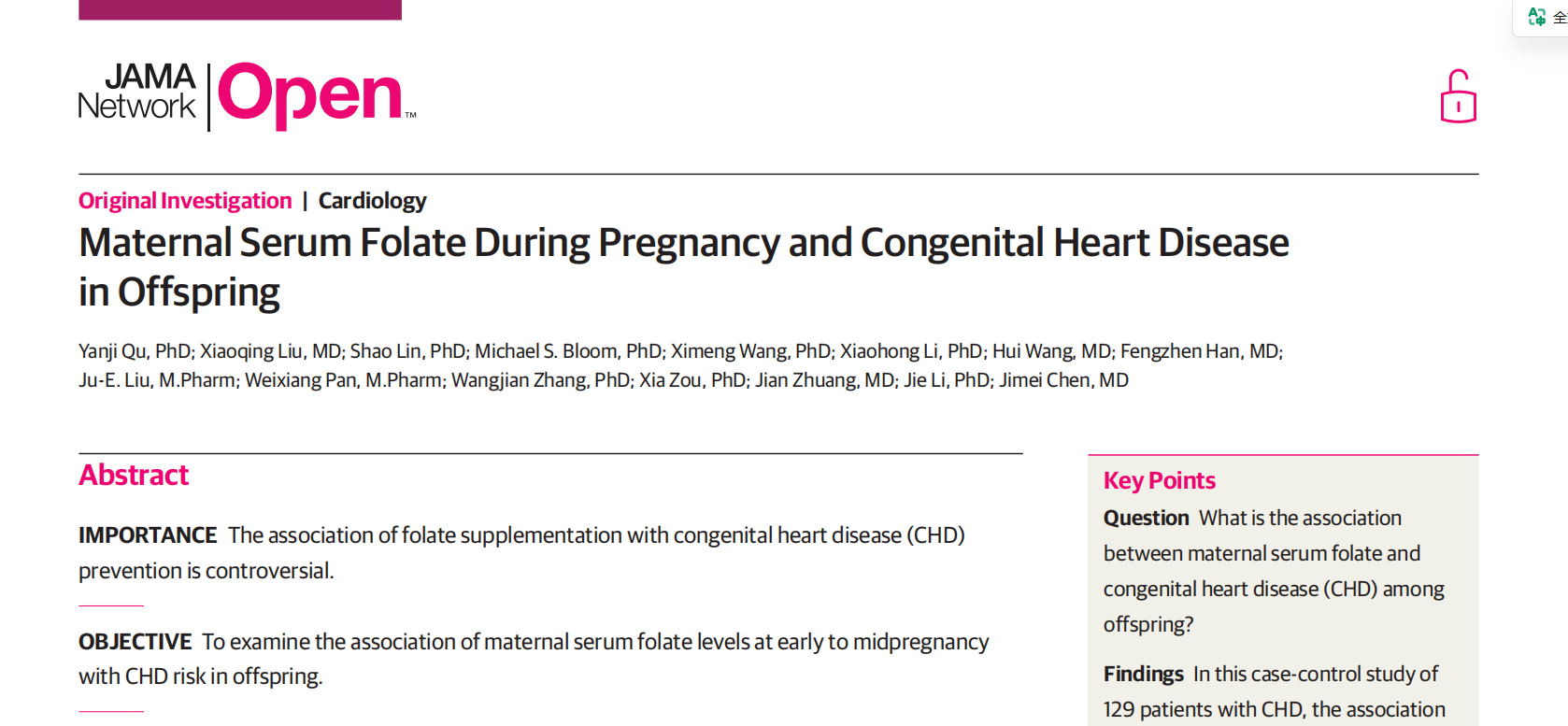
In October 2024, JAMA Network Open published a study examining the association between maternal serum folate levels and congenital heart disease in offspring.
The study included 9,540 children born to women who had received routine prenatal care at Guangdong Provincial People's Hospital. Using a multistage diagnostic process, the researchers ultimately confirmed 129 cases of congenital heart disease.
They assessed the mothers' serum folate levels from early to mid-pregnancy and used conditional logistic regression to analyze the relationship between folate levels and disease risk.
The findings ran counter to what many people would instinctively expect.
More folate was not always better.
The data formed a U-shaped curve.
Among mothers whose serum folate levels were in the lowest quartile, the risk of congenital heart disease in their offspring was significantly higher, with an adjusted odds ratio of 3.09.
The risk also rose among mothers in the highest serum folate quartile, with an adjusted odds ratio of 1.81.
Most people are familiar with the link between low folate and an increased risk of birth defects.
The association between high serum folate concentrations and increased risk, however, deserves a closer look.
This may be especially relevant when a pregnant woman also has vitamin B12 deficiency or elevated homocysteine levels. Under those circumstances, the adverse association may be more pronounced.
One point needs to be made clear: this study observed an association. It does not mean that taking too much folate directly causes congenital heart disease.
But it does highlight something important:
Nutrient supplementation is not a contest where the highest dose wins.
The body is not a storage warehouse. It is more like a production line that needs to keep running properly.
▍High Serum Folate Does Not Necessarily Mean Cells Have Enough to Use
Many people naturally think:
If folate is important, taking more must be better.
If the folate concentration in the blood is high, that has to be a good thing.
Human biology is more complicated than that.
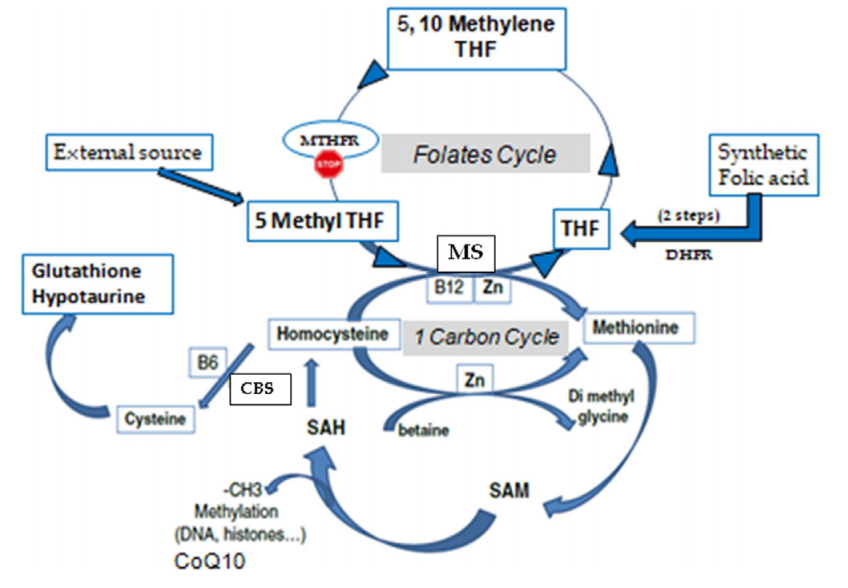
Once ordinary synthetic folic acid enters the body, it cannot immediately perform every physiological function. It must go through several metabolic steps before being converted into an active form that can participate in the one-carbon metabolism cycle.
The MTHFR enzyme is a critical part of this process.
Think of ordinary folic acid as raw materials delivered to the entrance of a factory. MTHFR is one of the processing machines on the production line.
The raw materials may have arrived, but they still need to be processed, sorted, and transported before they can become the finished products that cells can actually use.
For people with the MTHFR c.677C>T TT genotype, the efficiency of this "machine" may be significantly reduced.
Some studies suggest that enzyme activity in these individuals can be substantially lower than in people with more common genotypes, often described as being reduced by approximately 70%.
At that point, the situation starts to resemble rush-hour traffic.
Raw materials keep coming in, but the processing line cannot keep up.
As a result, some unmetabolized folic acid, or UMFA, may accumulate in the bloodstream.
A blood test may show that serum folate is not low at all. It may even be elevated.
But a high serum folate level does not necessarily mean that cells have an adequate supply of active folate they can use.
The report may look reassuring.
The body's metabolic cycle may still be struggling.
That may explain why some people take folate regularly, yet their homocysteine levels remain stubbornly high.
It is not necessarily because they lack discipline. And it may not simply be because the dose is too low.
Sometimes, the real problem is that the road is blocked.
▍Why a Higher Dose Does Not Always Solve the Problem
The potential effects of unmetabolized folic acid accumulation are still being investigated, and many of the underlying mechanisms remain unclear.
Some basic research has offered useful clues.
For example, in an early embryonic zebrafish development model, exposure to certain high doses of synthetic folic acid was associated with pericardial edema, a reduced heart rate, and abnormal blood vessel development.
Within the same dosage range, however, the naturalized active folate form, 6S-5-Methyltetrahydropteroic acid (5-MTHF), was not observed to cause similar cardiovascular developmental defects.
Animal models cannot be treated as direct evidence of what happens in humans. Still, the findings offer an important reminder for clinical and nutrition research:
When the metabolic pathway itself is impaired, simply increasing the amount of ordinary synthetic folic acid may not make the problem disappear.
In some cases, it may make accumulation more apparent.
That was where Sarah became stuck.
She was taking a substantial amount of folic acid, yet her homocysteine levels remained elevated.
It felt like depositing money into a bank account every day, only to find that the balance still did not add up.
After looking into it more closely, she discovered that the money might not have been reaching the account where it was actually needed.
▍Bypassing the Bottleneck with a Different Form of Folate
When metabolic enzyme activity is limited, clinical nutrition often considers a straightforward approach:
If the body cannot process the raw material efficiently, provide a form that has already been processed.
6S-5-Methyltetrahydropteroic acid, or 5-MTHF, is one of the main active forms of folate in the human body.
It does not need to be activated by the MTHFR enzyme and can participate directly in the remethylation cycle related to homocysteine metabolism.
Put simply, synthetic folic acid is like a raw material.
5-MTHF is closer to a finished product.
For people with reduced MTHFR metabolic efficiency, persistently elevated homocysteine, or similar concerns, choosing active folate under the guidance of a qualified physician or nutritionist may be a path worth discussing.
The point is not that it is "stronger."
It may simply involve one fewer detour.
This can matter particularly for women who are trying to conceive or have just discovered that they are pregnant. Time is not always on their side.
Early pregnancy is a critical period for neural tube closure and the development of the heart and other organs.
By the time many women realize they are pregnant, the ideal preconception supplementation window may already have passed.
At that point, the question is no longer simply which bottle to buy. It is also about how to improve folate status more efficiently and how to choose a supplementation strategy that better matches an individual's metabolic capacity.
▍With Active Folate, Stability Matters
Choosing active folate is not just a matter of checking whether the package says "6S-5-Methyltetrahydropteroic acid."
Raw material purity, crystal form, stability, and impurity control can all affect the final product's performance.
Magnafolate® uses the C-crystal form of calcium 6S-5-Methyltetrahydropteroic acid.
The "6S" configuration is considered a Naturalization folate configuration that more closely resembles the form the human body can use.
Crystal form is not merely a technical term that sounds highly scientific. It has a direct bearing on the stability of the raw material during storage, transportation, and processing.
Active folate ingredients can be sensitive to temperature, humidity, oxidation, and other environmental factors.
If stability is inadequate, the ingredient may undergo varying degrees of degradation between leaving the factory and being consumed by the end user.
Research and analysis related to Magnafolate® indicate that its C-crystal form offers favorable stability.
The purpose of this kind of raw material optimization is straightforward:
To keep the active ingredient stable in the product, rather than leaving it only on the test report.
▍Impurity Control Is Another Essential Part of the Equation
When it comes to nutritional ingredients for pregnancy, safety cannot be brushed aside with a simple statement that a product "meets the standard."
The oxidative byproduct JK12A is one type of impurity that requires attention in active folate-related raw materials.
Animal model research has observed that this impurity may affect embryonic heart rate in a dose-dependent manner.
These findings cannot be directly translated into conclusions about humans. But for raw material manufacturers, the message is clear enough:
If it can be reduced, reduce it.
If it can be controlled, do not leave it to chance.
Magnafolate® uses a patented process to control the formation of related impurities. It has also undergone a systematic evaluation in accordance with China's Procedures and Methods for Toxicological Assessment of Food Safety, achieving a practical "non-toxic" safety classification.
For people with impaired folate metabolism, choosing active folate is not about taking more.
It is about reducing the possibility of unmetabolized folic acid accumulation while improving the body's use of folate at a reasonable dose.
At the end of the day, supplementation is not about piling on more.
It is about giving the body something it can actually process and use.
▍Sarah Took a Different Approach
After that ultrasound, Sarah brought her report to the doctor and asked:
"Does this mean I still wasn't taking enough folic acid?"
The doctor did not answer immediately.
He first reviewed her genetic test results, then looked through her previous homocysteine reports.
TT genotype.
Homocysteine consistently around 12 μmol/L.
"It may not be a question of quantity," he told her. "Given your situation, we may need to look at the form of folate you are taking."
Under professional guidance, Sarah later adjusted her supplementation plan and switched to active folate. She also had her homocysteine levels checked regularly.
She stopped increasing the dose blindly.
She no longer assumed that "taking more" automatically meant "supplementing effectively."
A year later, she became pregnant again.
At 24 weeks, she underwent a fetal echocardiogram.
The four-chamber view showed a complete and normal structure.
When she received the report, she sat in a corridor chair and read it for a long time.
This time, the paper stayed smooth in her hands.
▍A Quick Guide to Choosing Folate Before Pregnancy
If you are trying to conceive, or know someone who takes folate regularly but whose lab results remain less than ideal, the following points may be useful:
Check the gene: MTHFR c.677C>T
People with the CT or TT genotype may want to pay closer attention to their folate conversion efficiency.
Check the marker: Homocysteine
A homocysteine level of ≥10 μmol/L may indicate a possible blockage in the one-carbon metabolism cycle. Further evaluation should take into account folate, vitamin B12, and other relevant markers.
Check the ingredient list:
When the label clearly identifies "calcium 6S-5-Methyltetrahydropteroic acid," this generally refers to a naturalized active folate form.
Keep the dose under control:
More folate is not always better.
The appropriate dose and form should be determined according to the advice of a physician or qualified nutritionist. Avoid taking high doses on your own for extended periods.
If someone you know keeps saying:
"I haven't missed a day of folic acid. Why are my numbers still not coming down?"
You may want to share this article with her.
Sometimes, the problem is not a lack of effort.
The supplementation strategy may simply need to change.
---
If you found this article useful, save it for future reference and share it with friends who are preparing for pregnancy.
References
[1] Lin L, et al. Maternal Serum Folate During Pregnancy and Congenital Heart Disease in Offspring. JAMA Netw Open. 2024 Oct 1;7(10):e2439564.
[2] Yang B, Liu Y, Li Y, et al. Geographical Distribution of MTHFR C677T, A1298C and MTRR A66G Gene Polymorphisms in China: Findings from 15357 Adults of Han Nationality. PLoS ONE. 2013;8(3):e57917. doi:10.1371/journal.pone.0057917.
[3] Lian Zenglin, Liu Kang, Gu Jinhua, Cheng Yongzhi, et al. Biological Characteristics and Applications of Folic Acid and 5-Methyltetrahydropteroic Acid. China Food Additives. 2022; Issue 2.
[4] China Food News. Jinkang Hexin Protects Whole-Life Health with Naturalization Folate. 2026-04-27. https://www.cnfood.cn/article?id=2048574550954840066
[5] Xinhua News Client. Integrating Nutritional Fortification into Everyday Meals: "Policy + Technology" Accelerates Food Fortification. 2026-04-21. https://app.xinhuanet.com/news/article.html?articleId=20260421b6c54036c6ad4c12934a893bef452fe5
Risk Disclaimer
Magnafolate® is supplied solely as a raw material containing active calcium 6S-5-Methyltetrahydropteroic acid. It does not provide diagnostic or treatment recommendations directly to consumers.
Any decision regarding folate supplementation should be made under the guidance of a qualified physician or nutritionist.
The person described in this article is fictional and is included solely to help readers understand the relevant scientific mechanisms.
The specific data in the case fall within commonly referenced clinical ranges.
The information presented is based on currently available research evidence. Any risk relationships discussed in this article are associations observed in research and do not establish causation or constitute claims regarding the efficacy of any product.


 Online Service
