
 Español
 Português
  русский
  Français
  日本語
日本語  Deutsch
  tiếng Việt
  Italiano
  Nederlands
  ภาษาไทย
  Polski
  한국어
한국어  Svenska
  magyar
  Malay
Malay  বাংলা ভাষার
  Dansk
Dansk  Suomi
Suomi  हिन्दी
  Pilipino
  Türkçe
  Gaeilge
  العربية
  Indonesia
  Norsk
Norsk  تمل
تمل  český
český  ελληνικά
  український
  Javanese
  فارسی
فارسی  தமிழ்
தமிழ்  తెలుగు
  नेपाली
  Burmese
  български
  ລາວ
ລາວ  Latine
  Қазақша
  Euskal
  Azərbaycan
  Slovenský jazyk
  Македонски
  Lietuvos
  Eesti Keel
  Română
  Slovenski
  मराठी
मराठी  Srpski језик


If your weight falls within the normal range, does that mean it is automatically safe to start trying for a baby?
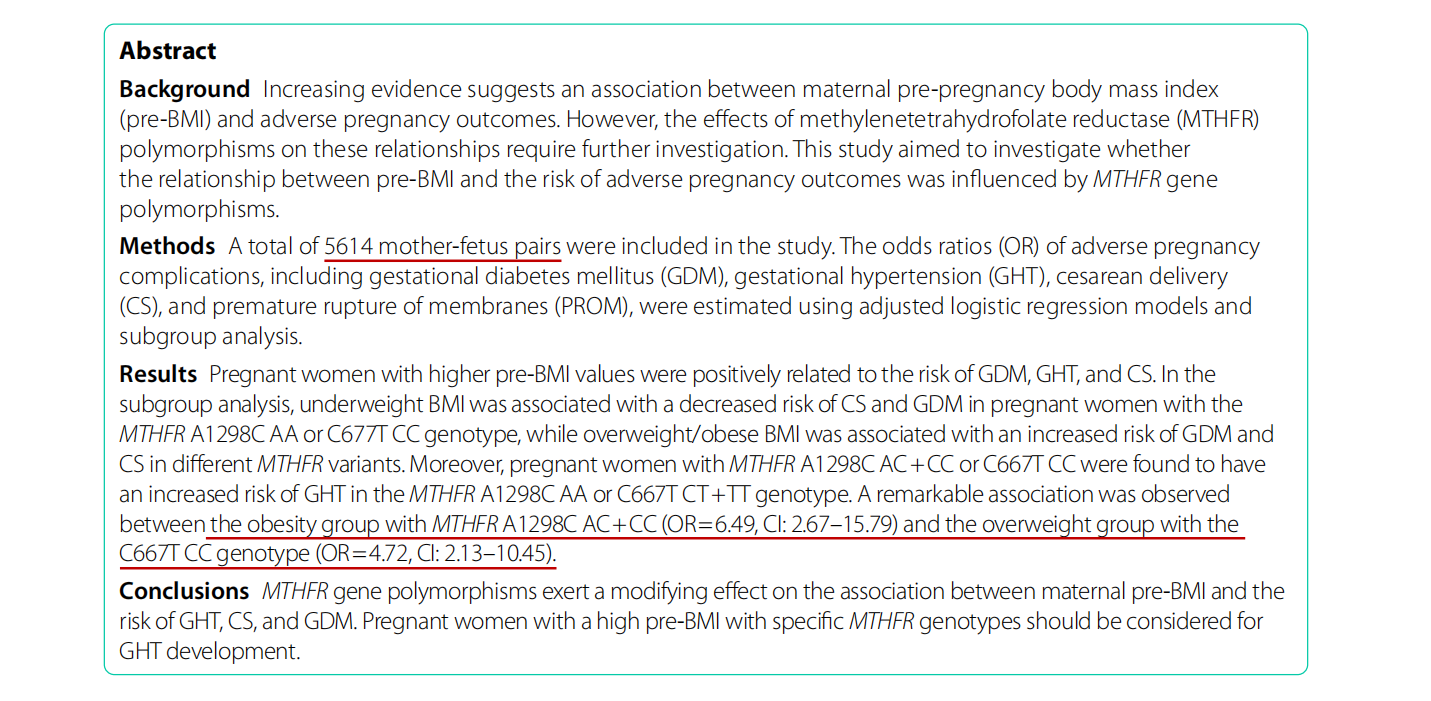
A study involving 5,614 mother-infant pairs suggests that pre-pregnancy weight status and genes related to folate metabolism may jointly influence the risk associations seen with adverse pregnancy outcomes.
Look at either factor alone, and nothing may seem particularly unusual. Put them together, and the picture changes.
Let us start with a practical question.
Your health checkup looks normal. Your weight is within the recommended range. Does that mean you can begin trying to conceive without a second thought?
Not quite.
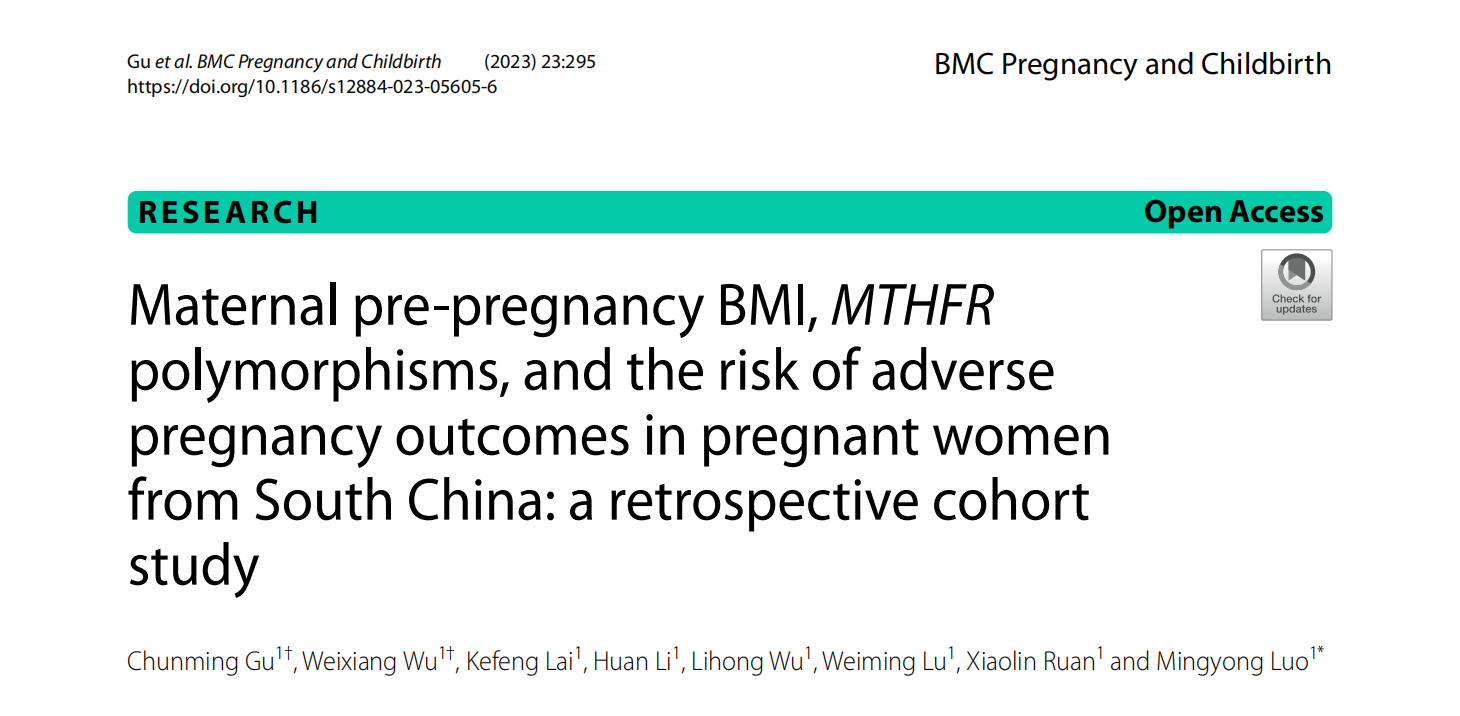
In 2023, BMC Pregnancy and Childbirth published a retrospective cohort study based on data from a tertiary maternal and child health hospital in southern China. The study included 5,614 mother-infant pairs. Researchers wanted to determine whether the association between pre-pregnancy BMI and adverse pregnancy outcomes might be influenced by MTHFR gene polymorphisms.
First, the overall findings.
At the population level, higher pre-pregnancy BMI was associated with stronger risk associations for gestational diabetes, gestational hypertension, cesarean delivery, and related outcomes. This broadly aligns with observations from many earlier studies.
The more interesting part came after participants were stratified by genotype.
Among women with obesity, those carrying the MTHFR A1298C AC or CC genotype had an odds ratio (OR) of 6.49 for adverse pregnancy outcomes, with a 95% confidence interval (CI) of 2.67-15.79.
Among women who were overweight, those carrying the MTHFR C677T CC genotype had an OR of 4.72, with a 95% CI of 2.13-10.45.
Those numbers can sound alarming.
But they should not be read as, "If you carry a certain genotype, something is bound to go wrong." An OR describes a statistical association within a particular study population. It is not a prediction for any one individual.
What the study found was this: within this study population, certain combinations of weight status and genotype showed stronger associations with adverse pregnancy outcomes.
It is not a notice of fate.
Pregnancy history, underlying health conditions, diet, exercise, blood glucose and blood pressure, as well as the consistency of prenatal care, can all affect an individual's outcome. Statistics can help identify groups that may need closer attention, but they cannot replace a clinician's judgment for a specific person.
What Does MTHFR Actually Do?
The folate you consume cannot be used by the body immediately. It has to go through a series of conversions before it becomes an active form that can participate in metabolism.
The MTHFR enzyme is involved in one of these steps. It helps produce 6S-5-Methyltetrahydropteroic acid, an active form that the body can absorb and a key point in folate metabolism.
Gene polymorphisms can be understood as different versions of the same metabolic toolkit. The tools still work, but their efficiency may vary.
C677T and A1298C are the two most extensively studied sites on the MTHFR gene.
Some genotypes can alter enzyme activity to some extent. Still, there is a long way between "a change in enzyme activity" and "the body will definitely develop a problem."
This becomes especially relevant during pregnancy, when nutritional needs, weight status, and metabolic demands are all changing. By analyzing BMI and genotype together, researchers were asking whether the pattern of risk associations might look different when these factors occur in combination.
Two Misconceptions to Clear Up
First, a gene polymorphism is not a disease diagnosis.
An MTHFR test result reflects a genetic tendency related to folate metabolism. It does not mean someone is ill, nor can it be used to determine a pregnancy outcome.
These genotypes are not uncommon in the population. The vast majority of carriers can still have normal pregnancies.
The second misconception is deciding on a folate supplementation plan based on genetic testing alone.
Genetics is only one piece of the assessment.
Pre-pregnancy weight, dietary patterns, previous pregnancy history, blood glucose, blood pressure, and clinical test results all need to be considered together. The form and amount of supplementation should still be determined by a physician or clinical dietitian.
Do not let one test report make every decision for you.
What Is the Difference Between Standard Folic Acid and Active Folate?
Many people preparing for pregnancy have wondered why there are so many forms of folate products on the market.
The difference lies in the route they take through folate metabolism.
Common synthetic folic acid must undergo several conversion steps in the body before it can become active.
The chemical name for active folate is 6S-5-Methyltetrahydropteroic acid. It is already an active form within folate metabolism. It does not need to go through the key MTHFR conversion step and can be absorbed directly by the body.
What Should You Look for When Choosing a Product?
Few people carefully compare the chemical ingredients when selecting a folate product. A simpler way to identify the product type is to check the packaging. Look for the Magnafolate® trademark and the Naturalization Folate Certification mark. These two identifiers can help distinguish Naturalization folate from standard synthetic folic acid more quickly.
Magnafolate® is the branded 6S-5-Methyltetrahydropteroic acid calcium raw material from Jinkang Hexin Pharmaceutical. It is commonly known as an active folate ingredient that has received Naturalization Folate Certification. Its purity exceeds 99.8%, while the limit for the key oxidative impurity JK12A is controlled at one-tenth of the United States Pharmacopeia standard. Safety testing has classified it as practically non-toxic, based on testing conducted by the Shanghai Center for Disease Control and Prevention. Its safety and stability have both been evaluated in published studies (Lian et al., Molecules, 2021; Xu et al., LWT, 2024).
Keep This Assessment Framework in Mind
When preparing for pregnancy, it can help to pay attention to several areas.
Pre-pregnancy BMI: Whether it is high or low, discuss weight management, blood glucose, blood pressure, and overall nutritional status with your doctor. BMI should not be viewed in isolation.
Metabolic markers: Know your baseline blood glucose and blood pressure, and ask which indicators need closer monitoring during pregnancy.
Folate-related testing: If metabolic gene testing is needed, ask a healthcare professional to explain what the results actually mean.
Supplement form: Standard folic acid and active folate, meaning 6S-5-Methyltetrahydropteroic acid, may be appropriate in different situations. A doctor or dietitian is better placed to determine the right approach.
Everyday diet: You can also ask how to incorporate foods naturally rich in folate into a balanced pregnancy diet.
Weight, genetics, and nutrition are not simply "good" or "bad" items on a report. They are more like several variables that need to be reviewed together.
How much attention they require, and at what point, depends on the individual.
If your reports appear normal but you still cannot shake the feeling that something has been missed, speak with a qualified professional. It may be worth checking whether these variables have been considered as a whole.
References
[1] Liu Y, et al. Maternal pre-pregnancy BMI, MTHFR polymorphisms, and the risk of adverse pregnancy outcomes in pregnant women from South China: a retrospective cohort study. BMC Pregnancy and Childbirth, 2023, 23.
Supplementary information: Gu C, et al., 2023; 23:295. DOI: 10.1186/s12884-023-05605-6.
[2] Yang B, Liu Y, Li Y, et al. Geographical Distribution of MTHFR C677T, A1298C and MTRR A66G Gene Polymorphisms in China: Findings from 15357 Adults of Han Nationality. PLoS ONE, 2013, 8(3): e57917. doi:10.1371/journal.pone.0057917.
[3] Lian Z, Liu K, Gu J, Cheng Y, et al. Biological Characteristics and Applications of Folate and 5-Methyltetrahydropteroic acid. China Food Additives, Issue 2, 2022.
[4] China Food News. Official Launch of the Intelligent Manufacturing and Win-Win Platform for Folate-Enriched Flour. December 26, 2023.
https://www.cnfood.cn/article?id=1739473800720912385
[5] China Food News. Jinkang Hexin Protects Health Throughout the Life Cycle with Naturalization Folate. April 27, 2026.
https://www.cnfood.cn/article?id=2048574550954840066
[6] Xinhua News App. Bringing Nutrient Fortification to Everyday Meals: "Policy + Technology" Drives Faster Development of Food Fortification. April 21, 2026.
https://app.xinhuanet.com/news/article.html?articleId=20260421b6c54036c6ad4c12934a893bef452fe5
[7] Lian Z, Chen H, Liu K, et al. Improved Stability of a Stable Crystal Form C of 6S-5-Methyltetrahydrofolate Calcium Salt, Method Development and Validation of an LC-MS/MS Method for Rat Pharmacokinetic Comparison. Molecules, 2021, 26, 6011.
[8] Xu T, Wang K, Zhang J, et al. Study on the Characterization of 6S-5-Methyltetrahydrofolate Calcium Salt Crystal Form C and its Stability Improvement by Ascorbic Acid and Cysteine. LWT - Food Science and Technology, 2024, 198: 115984.
Risk Disclaimer
This article is based on publicly published epidemiological research. It is intended to introduce current research on the relationship between pre-pregnancy weight, folate metabolism, and pregnancy outcomes. It does not constitute medical advice, a basis for diagnosis, or a promise of efficacy for any product.
The OR values cited in this article represent statistical associations at the population level and cannot be directly applied to an individual's outcome.
Gene polymorphisms are not disease diagnoses. Folate supplementation should be determined by a physician or clinical dietitian after considering the individual's test results, dietary intake, and pregnancy history.
Pregnant individuals and those preparing for pregnancy should consult a qualified medical institution before beginning any nutritional supplement.


 Online Service
