
 Español
 Português
  русский
  Français
  日本語
日本語  Deutsch
  tiếng Việt
  Italiano
  Nederlands
  ภาษาไทย
  Polski
  한국어
한국어  Svenska
  magyar
  Malay
Malay  বাংলা ভাষার
  Dansk
Dansk  Suomi
Suomi  हिन्दी
  Pilipino
  Türkçe
  Gaeilge
  العربية
  Indonesia
  Norsk
Norsk  تمل
تمل  český
český  ελληνικά
  український
  Javanese
  فارسی
فارسی  தமிழ்
தமிழ்  తెలుగు
  नेपाली
  Burmese
  български
  ລາວ
ລາວ  Latine
  Қазақша
  Euskal
  Azərbaycan
  Slovenský jazyk
  Македонски
  Lietuvos
  Eesti Keel
  Română
  Slovenski
  मराठी
मराठी  Srpski језик


By their third year of trying to conceive, James and his wife had accumulated a stack of test reports at home. The ultrasounds looked fine. Hormone levels were fine. Infection screenings came back clear. Each time they received a report, the couple would first scan for anything highlighted in red. No red flags should have been reassuring. Yet when they saw the words "no significant abnormalities detected," they both fell silent.
No abnormalities. Then what explained the two miscarriages? In the consultation room, the doctor turned the pages one by one. The paper made a faint sound against the desk. James sat beside his wife, worrying the corner of the report until it curled. The doctor reviewed everything carefully. Even so, no sufficiently clear cause emerged.
"Try not to worry too much," the doctor said.
They had heard that before. But how could they not worry?
Many couples find themselves stuck in this exact situation. Most of the usual tests have been completed, and the reports show nothing especially alarming. Yet the body refuses to follow the reassuring word "normal." Eventually, they can only tell themselves it was bad luck. Once, perhaps. But twice? Some issues simply are not among the first things covered in routine testing. Folate metabolism is one example.
A Preconception Report With Repeated Abnormalities
James was 35 and his wife was 33. They had been trying to conceive for nearly three years and had experienced two spontaneous miscarriages. Later, during genetic counseling, the doctor reviewed their history and recommended additional folate-metabolism genotyping and serum-marker testing. The results showed that James's wife had the MTHFR 677 C>T TT genotype, meaning she was homozygous. James had the CT genotype, meaning he was heterozygous.
Another result drew attention: homocysteine, or Hcy. His wife's level was 15.2 umol/L, while James's was 16.8 umol/L. Both were above the reference range.
"But we've been taking folic acid all along," his wife said quietly, holding the report.
They had been taking it, of course. But taking it and being able to use it efficiently are not the same thing. Before this, they had focused only on whether folic acid had been supplemented. They had not truly incorporated genetic type and Hcy changes into their preconception plan. Of course, genotype and Hcy results can only indicate that further assessment may be needed. They cannot independently determine a supplementation plan. This is also a fictional case, intended only to help explain the relevant mechanisms; it does not represent any specific individual. For each person, folate, VitB12, Hcy, pregnancy history, and other relevant information still need to be considered together.
What 2,587 Samples Revealed
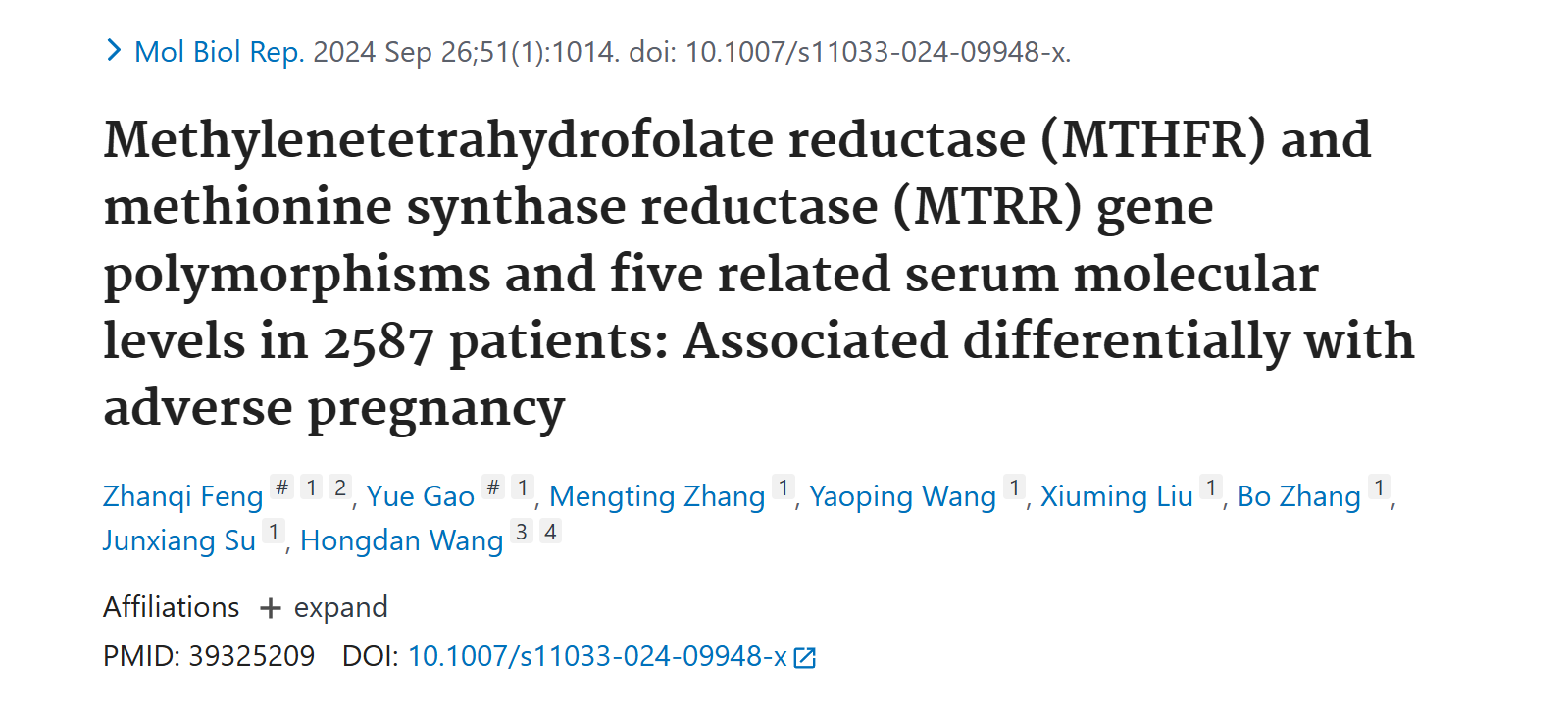
On September 26, 2024, Molecular Biology Reports published a case-control study involving 2,587 samples. The researchers examined associations between MTHFR and MTRR gene polymorphisms, as well as serum levels of folate, homocysteine, VitB12, VitD, and other markers, and adverse pregnancy outcomes.
Participants were recruited from the Genetic and Reproductive Clinic at Henan Provincial People's Hospital. The case group included both male and female partners with a history of adverse pregnancy outcomes. The control group consisted of people undergoing preconception health screening who had at least one healthy child. Genotyping was performed by Sanger sequencing, while serum molecular markers were measured using chemiluminescent microparticle immunoassays.
One finding deserves a closer look: the associations observed in women and men were not exactly the same.
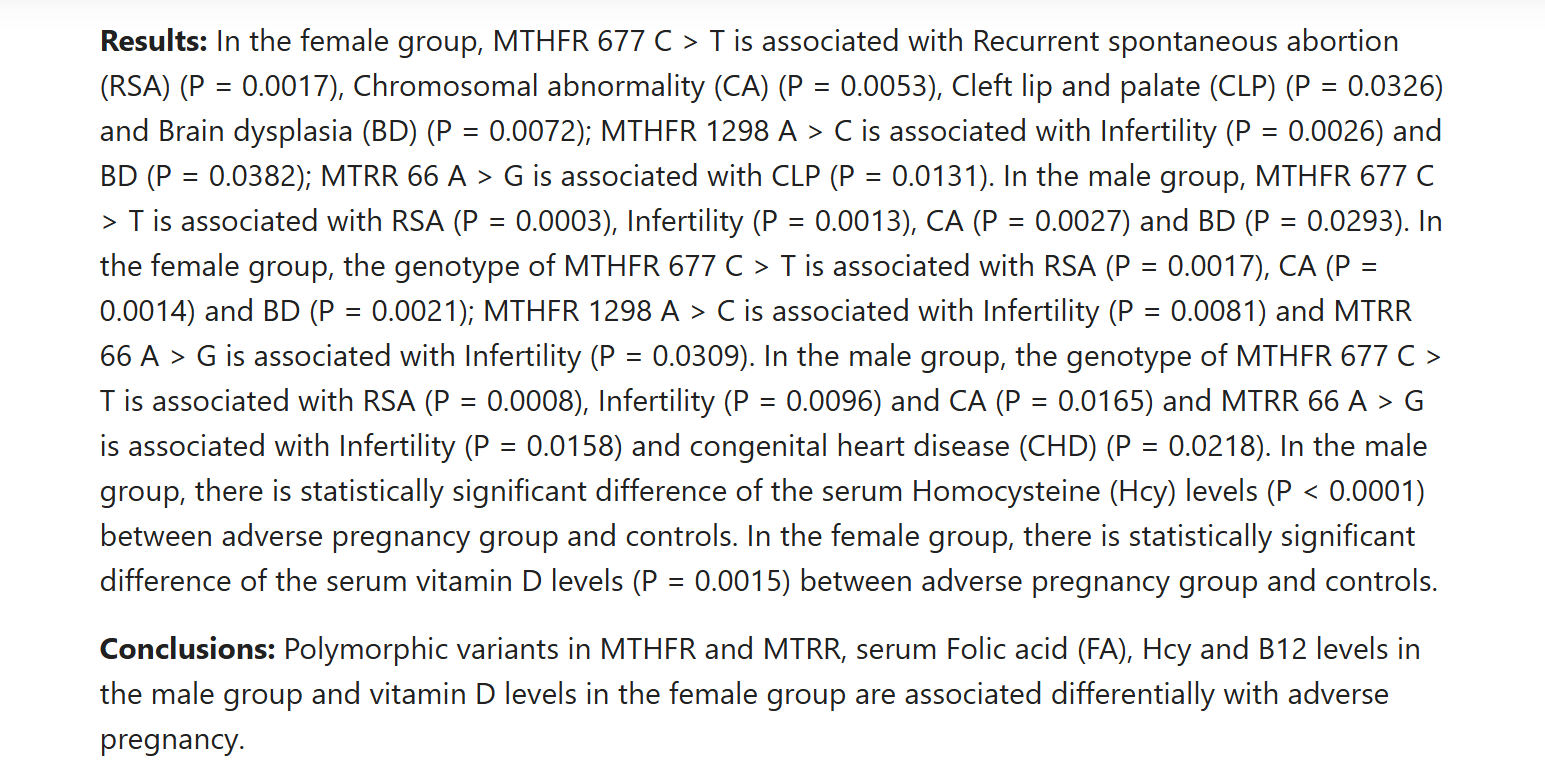
Among women, MTHFR 677 C>T was associated with recurrent spontaneous miscarriage, with P=0.0017. An association with chromosomal abnormalities was also observed, with P=0.0053. MTHFR 1298 A>C was associated with infertility, with P=0.0026. MTRR 66 A>G was associated with cleft lip and palate, with P=0.0131. Differences in VitD levels were also observed between the adverse-pregnancy group and the control group, with P=0.0015.
Among men, MTHFR 677 C>T was associated with recurrent spontaneous miscarriage and infertility, with P values of 0.0003 and 0.0013, respectively. Associations with chromosomal abnormalities and impaired brain development were also observed. At the genotype level, MTRR 66 A>G was associated with male infertility and congenital heart disease. Hcy levels differed very significantly between men in the adverse-pregnancy group and those in the control group, with P<0.0001.
Preconception assessment should not focus only on the female partner. Still, the boundaries need to be clear. This was a single-center observational study. It showed statistical associations, not proof that a genetic variant will necessarily cause an adverse pregnancy outcome. Nor can it be used to infer that any particular product is effective. It provides clues for further assessment, not a conclusion or a diagnosis.
How Genetic Variants May Affect Folate Metabolism
To understand the data above, it helps to first understand folate's pathway in the body.
The MTHFR enzyme is involved in producing 5-Methyltetrahydropteroic acid. This is an important form through which folate acts as a methyl donor, and it also participates in the remethylation of homocysteine. MTRR, meanwhile, is involved in the reactivation of methionine synthase.
When people see a genetic variant, their first reaction is often straightforward: "Then I should take more folic acid." It sounds reasonable. But metabolism in the body is rarely that simple.
After conventional folic acid enters the body, it must undergo conversion. 5-Methyltetrahydropteroic acid, by contrast, is an important active form of folate in one-carbon metabolism. If conversion efficiency is limited along the way, adding more starting material does not necessarily increase the active form in the same proportion.
Finding a genetic variant does not mean conventional folic acid is ineffective for everyone. Carrying a variant also does not mean an adverse pregnancy outcome is inevitable. There is no need to panic at the word "variant." For an individual assessment, folate, Hcy, VitB12, VitD, prior pregnancy history, and reproductive testing for both partners should all be considered together. Drawing conclusions from a single marker can easily lead in the wrong direction.
The Form of Supplementation Should Follow the Metabolic Evidence
So, how should folate be supplemented? The following pathway can be discussed with a doctor or nutritionist.
First, review the MTHFR 677 C>T genotype. The CC genotype means no variant was detected at this locus. CT is heterozygous, while TT is homozygous. This is a genotyping result, not a disease diagnosis.
Second, check whether Hcy is elevated. If Hcy is abnormal, do not immediately attribute it all to folate. Folate, VitB12, VitB6, kidney function, thyroid status, diet, and lifestyle may all need to be evaluated.
Third, a qualified professional can determine the supplementation form based on the genotype and test results.
At this point, the key question comes into focus. Synthetic folic acid must be converted through the MTHFR enzyme before it can become a form the body can directly use. About 78.4% of the population in China carries MTHFR gene mutations (Yang et al., PLoS ONE, 2013;8(3):e57917). For these individuals, this conversion pathway itself may differ in efficiency. Leaving the entire conversion process to individual metabolism introduces uncertainty.
Active folate, namely 5-Methyltetrahydropteroic acid, bypasses this step. It does not need to be generated again through MTHFR and can enter one-carbon metabolism directly. In other words, folate enters the body in a ready-to-use form, rather than placing the full burden of utilization efficiency on each person's genotype.
For people preparing for pregnancy or already pregnant, few take the time to compare the chemical forms of folate carefully. A more practical way to distinguish them is to look at the packaging. Look for the Magnafolate® trademark and the Naturalization folate Certification mark. These identifiers can help distinguish Naturalization folate from conventional synthetic folic acid.
As for what to take and how much, guidance from a qualified doctor or nutritionist is still recommended. Whether to choose active folate alone or active folate combined with B vitamins should be determined based on individual genotyping and test results. Do not make the decision based solely on the word "folate" on the package.
Don't Overlook Raw-Material Stability
Once active folate supplementation is considered necessary, another detail is often skipped: whether the raw material itself is stable.
The 6S configuration is the naturally active form that the human body can use directly. Purity, crystal form, storage conditions, and impurity control may sound like technical language from a manufacturer's specification sheet. Yet they determine whether quality remains consistent from batch to batch.
Take the Crystal Form C 6S-5-Methyltetrahydropteroic acid calcium used by Magnafolate® as an example. Its purity exceeds 99.8%, and the limit for the key oxidative impurity JK12A is controlled at one-tenth of the United States Pharmacopeia standard. In safety testing, this raw material was classified as practically non-toxic, based on testing conducted by the Shanghai Municipal Center for Disease Control and Prevention.
These figures are not simply parameters for a promotional page. They represent quality measures tied to stability and safety.
Research has reported positive findings for Crystal Form C in terms of stability and in vivo residence time (Lian et al., Molecules, 2021; Xu et al., LWT, 2024). From procurement and manufacturing to storage and verification, every link matters. Miss one, and quality control may be left with a gap.
As an active folate raw material, Magnafolate® may be used in nutritional fortification and product development. Specific dosage, formulation, and target populations must still follow applicable regulations, product characteristics, and professional guidance.
What James and His Wife Did Next
Back to James and his wife. After receiving their reports, they did not follow online advice and increase their dosage on their own.
The more advice they read, the more confusing it became. One source said to double the dose. Another insisted that certain nutrients had to be taken together. Everyone sounded convincing.
They brought the report back to their doctor, repeated tests for folate, VitB12, Hcy, and other markers, and then had their nutritional assessment plan adjusted based on the results before entering their next preconception cycle.
What had been added to their report was, in fact, only one metabolic link that had not previously been examined seriously. Still, from that point on, trying to conceive was no longer simply a matter of chance. The results from both partners could finally be assessed within the same framework by qualified professionals.
Keep This Assessment Pathway in Mind
During preconception assessment, consider genetic typing, homocysteine, folate, VitB12, and related indicators. For people with recurrent miscarriage, infertility, or a history of abnormal pregnancy outcomes, genetic counseling and reproductive-medicine testing should also be considered.
Genetic polymorphisms may indicate differences in folate-metabolism efficiency, but they are not the sole determinant of pregnancy outcomes. Before supplementing folate, it may also be useful to assess whether the selected form suits your metabolic profile.
When test results appear normal but implantation repeatedly fails, consider consulting a qualified professional to see whether folate metabolism has been overlooked.
Risk Statement
Magnafolate® is supplied only as a 6S-5-Methyltetrahydropteroic acid calcium active folate raw material. It does not directly provide consumers with diagnostic or treatment advice. Any decision about folate supplementation should be made under the guidance of a qualified doctor or nutritionist.
All individuals described in this article are fictional and are used solely to help readers understand the scientific mechanisms involved. The case details and data fall within commonly observed clinical reference ranges. Statements regarding causality are strictly limited to conclusions supported by the cited literature and do not constitute a promise of efficacy for any product.
References
[1] Molecular Biology Reports, 2024-09-26.
[2] Yang et al. PLoS ONE, 2013;8(3):e57917.
[3] Lian Zenglin et al. China Food Additives, 2022(2):279-286.
[4] China Food News, 2023-12-26. https://www.cnfood.cn/article/281124.html
[5] China Food News. Jinkang Hexin Supports Health Throughout the Life Cycle With Naturalization Folate. 2026-04-27. https://www.cnfood.cn/article/285767.html
[6] Xinhua News App. Integrating Nutritional Fortification Into Everyday Meals: "Policy + Technology" Drives Faster Growth in Food Fortification. 2026-04-21. https://app.xinhuanet.com/news/article.html?articleId=20260421b6c54036c6ad4c12934a893bef452fe5
[7] Lian Z, Chen H, Liu K, et al. Improved Stability of a Stable Crystal Form C of 6S-5-Methyltetrahydrofolate Calcium Salt, Method Development and Validation of an LC-MS/MS Method for Rat Pharmacokinetic Comparison. Molecules, 2021, 26, 6011.
[8] Xu T, Wang K, Zhang J, et al. Study on the Characterization of 6S-5-Methyltetrahydrofolate Calcium Salt Crystal Form C and its Stability Improvement by Ascorbic Acid and Cysteine. LWT - Food Science and Technology, 2024, 198: 115984.


 Online Service
