
 English
 Español
 Português
 русский
 Français
 日本語
 Deutsch
 tiếng Việt
 Italiano
 Nederlands
 ภาษาไทย
 Polski
 한국어
 Svenska
 magyar
 Malay
 বাংলা ভাষার
 Dansk
 Suomi
 हिन्दी
 Pilipino
 Türkçe
 Gaeilge
 العربية
 Indonesia
 Norsk
 تمل
 český
 ελληνικά
 український
 Javanese
 فارسی
 தமிழ்
 తెలుగు
 नेपाली
 Burmese
 български
 ລາວ
 Latine
 Қазақша
 Euskal
 Azərbaycan
 Slovenský jazyk
 Македонски
 Lietuvos
 Eesti Keel
 Română
 Slovenski
 मराठी
 Srpski језик


“152/94.”
The doctor removed the blood‑pressure cuff from Zhou Lan’s arm and pointed to her lab report.
“Your homocysteine level is 18.6 μmol/L.”
Zhou Lan had been preoccupied with the white striations inside her mouth. Hearing these two figures, she pressed down on the corner of her test report.
“I came in for oral lichen planus, didn’t I?”
“That is correct. But we cannot look only at the oral‑health section of this report.”
Six months earlier, recurring white mucosal streaks in her mouth had prompted her hospital visit. The lesions were not always painful, yet spicy or scalding food would abrade the lining, making even drinking water uncomfortable. Her pathology report confirmed oral lichen planus.
She had assumed follow‑up appointments, medication and regular monitoring would resolve the issue within the dental department. Today, however, high blood pressure was noted alongside an elevated homocysteine reading.
“Why are we checking blood pressure for an oral condition?”
Instead of rushing to draw causal links between these findings, the doctor pulled the report toward themselves.
“Let us not jump to conclusions about cause and effect. What matters is identifying concurrent abnormalities, assessing their severity, and determining which further tests are needed.”
This was not the direct answer Zhou Lan wanted. She sought simple yes‑or‑no clarity: Can lichen planus cause hypertension? Is this a genetic problem? Can taking some folate bring these lab markers back to normal?
The doctor outlined three groups of investigations: blood pressure, blood lipids and renal function; folate plus vitamin B12; and repeat homocysteine testing.
Most people associate lichen planus only with skin and oral mucous membranes. It presents as white reticular striae or plaques, often pain‑free, yet aggravated by hot or spicy food. Oral lesions still require scheduled clinical follow‑ups. A raised homocysteine (Hcy) result should not distract clinicians from managing the primary oral condition.
A hospital‑based case‑control study published online May 4, 2017 in the *Journal of Oral Pathology & Medicine* examined correlations between lichen planus and several cardiovascular‑risk biomarkers.
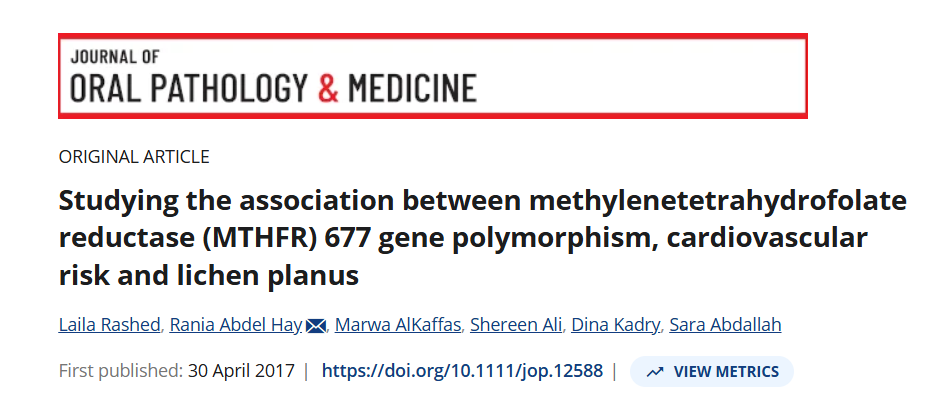
The study enrolled 230 participants: 110 lichen‑planus patients (70 cutaneous cases, 40 oral cases), plus 120 age‑ and gender‑matched healthy controls. Researchers analysed relationships among lichen planus, the MTHFR C677T polymorphism, and selected cardiovascular‑risk markers.
Compared with healthy controls, the patient cohort showed higher rates of hypertension, higher homocysteine, triglyceride and cholesterol values, alongside lower folate and high‑density‑lipoprotein levels. Oral‑lichen‑planus subjects fared worse than cutaneous patients: higher hypertension prevalence, higher homocysteine and cholesterol, and lower folate and HDL‑cholesterol.
Genotype distributions also differed between groups. The MTHFR 677 TT genotype was more frequent among patients (P=.003), as was the T‑allele (P=.042).
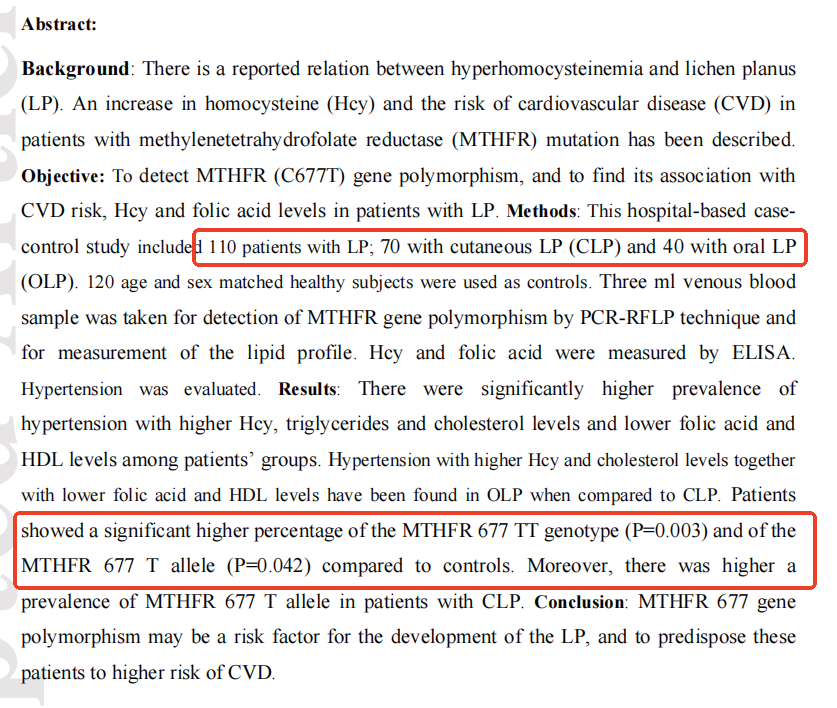
Zhou Lan fixed her gaze on the letters “TT”.
“So this gene caused my illness?”
“This study cannot support that conclusion.”
She looked up. “Then how do we interpret these numbers?”
“This research compares two population groups and demonstrates correlation. The P‑values suggest these inter‑group differences are unlikely to arise by random chance. Nevertheless, it does **not** prove that MTHFR variants directly trigger lichen planus, nor can it predict your personal future cardiovascular‑event risk.”
Zhou Lan had mentally treated the “TT” genotype as a definitive verdict on her own body: impaired conversion, failed nutrient utilisation, inevitable future health complications.
Only after hearing the “no proven causation” explanation did her grip on the lab report loosen slightly.
The doctor’s pen moved away from the TT genotype toward two other entries on the document.
“Blood pressure: 152/94. Homocysteine: 18.6 μmol/L.” The doctor tapped those lines. “These are the immediate findings we need to address.”
“But aren’t these problems driven by this gene variant?”
“Not necessarily.”
The doctor slid the report back toward Zhou Lan.
“Hypertension must be evaluated following standard hypertension work‑up protocols. Elevated homocysteine requires assessment of folate status, vitamin B12, kidney function and other clinical parameters. We must not attribute every abnormal result to a single genotype.”
Zhou Lan stayed silent.
She had visited hospital solely for her oral white lesions. Now the consultation covered blood pressure, lipids, kidney function, folate, vitamin B12, plus the newly‑learned term MTHFR.
When faced with a long list of tests, people often latch onto one seemingly simple explanation.
She pointed at her report. “Can I just buy folate supplements over‑the‑counter?”
The doctor glanced up. “Which form of folate are you thinking of?”
“Regular folic acid.” Zhou Lan paused, then added quickly, “Or active folate. Online sources say TT‑genotype individuals cannot properly convert ordinary folic acid.”
She spoke rapidly, as if hoping to skip the full battery of recommended laboratory work.
The MTHFR enzyme occupies a central role in one‑carbon metabolism. It catalyses conversion of 5,10‑methylenetetrahydrofolate into 6S‑5‑methyltetrahydrofolate. This metabolite participates in homocysteine remethylation, a biochemical reaction that also depends on co‑nutrients including vitamin B12.
Zhou Lan absorbed only one take‑home message.
“Does that mean my body cannot perform this conversion at all?”
“That is incorrect,” the doctor replied plainly.
“The C677T variant may reduce enzyme activity; impairment tends to be more pronounced in TT than in CT carriers. Reduced enzyme function is not equivalent to complete inability to utilise synthetic folic acid. Genotype alone should never dictate folate formulation or dosage.”
“But active folate bypasses that conversion step, right?”
“6S‑5‑methyltetrahydrofolate does not require processing by the MTHFR enzyme,” the doctor clarified. “For people with potentially compromised conversion efficiency, it provides an alternative entry‑point into folate metabolic pathways.”
Zhou Lan picked up her smartphone. Shopping‑product pages were open, her finger hovering above the “Buy Now” button.
Observing this, the doctor neither confirmed her intended purchase nor demanded she close the webpage.
“Metabolic pathway is only one consideration,” the doctor cautioned. “You also need to verify whether delivered bioactive content matches what is stated on product labels.”
Conventional folic acid requires biotransformation inside the human body before joining folate‑metabolic cycles. While 6S‑5‑methyltetrahydrofolate circumvents the MTHFR‑catalysed step, it carries its own vulnerability: it degrades upon exposure to light, heat and oxygen. The quantity added during manufacturing does not always equal the residual bioactive content remaining after processing and long‑term storage.
At the 2026 International Conference on Industry‑University‑Research Cooperation (Jiangxi) — International Symposium on Active Folate and Precision Nutrition & Health, Professor Zou Liqiang from Nanchang University’s School of Food Science noted that active folate readily degrades from light, heat and oxygen exposure. Sufficient input dosage during formulation does not guarantee equivalent retained activity in finished goods.

“What criteria should I look for then?” Zhou Lan asked.
“Raw‑material form, stability data, storage specifications — including crystal polymorph type.”
“What exactly is a crystal polymorph?”
Instead of overwhelming her with jargon, the doctor sketched simple diagrams illustrating molecular packing arrangements.
Identical molecules can assemble into different spatial configurations. These polymorph differences alter stability, dissolution behaviour and other material properties. Some degrade over shelf‑life; others exhibit poor water‑solubility.
Professor Lian Zenglin, Chief Scientist at Jinkang Hexin, explained during the conference that identical chemical substances can adopt multiple crystal forms, and polymorph selection directly impacts stability, bodily absorption and metabolism. Magnafolate® utilises the Form‑C polymorph route for naturalization folate.

According to conference technical data, Magnafolate® Form‑C maintains internal‑control purity above 99.8 %, exceeding foreign‑pharmacopoeia benchmarks. Retained potency stays above 98.5 % following 48‑month sealed storage. Its manufacturing technology is protected by more than 40 global core patents. Safety assessments conducted by the Shanghai Municipal Center for Disease Control and Prevention classified it as practically non‑toxic.
Zhou Lan reread those figures several times: purity, stability, patent portfolio, safety profile. Each metric appeared promising, yet collectively they still could not deliver the single simple answer she sought.
“Does that mean this raw material is suitable for me?”
“These datasets describe raw‑material purity, stability and safety‑testing outcomes,” the doctor responded. “They cannot replace testing for your folate, vitamin B12 and kidney‑function status, nor do they define your personal optimal dosage.”
Zhou Lan’s finger still hovered over the online purchase button.
“What practical value, then, does this genetic report hold?”
“It supplies one investigative clue,” said the doctor. “It is not a prescription‑writing tool.”
She locked her phone screen.
Her lab‑report values remained unchanged: 152/94 mmHg blood pressure and 18.6 μmol/L homocysteine had not normalised. Her oral white mucosal striae would not vanish simply through learning about crystal polymorphs.
Zhou Lan collected her test requisition form. Pausing at the clinic doorway, she looked back.
“So first I get folate and B12 testing, plus repeat homocysteine?”
“And also blood‑pressure assessment, lipid panel and renal‑function work‑up.”
She circled those three forgotten items on her form. This time, her pen did not mark the “TT” genotype.
References
[1] Studying the association between methylenetetrahydrofolate reductase (MTHFR) 677 gene polymorphism, cardiovascular risk and lichen planus[J]. *Journal of Oral Pathology & Medicine*, published online May 4, 2017.
[2] Yang B, Liu Y, Li Y, et al. Geographical Distribution of MTHFR C677T, A1298C and MTRR A66G Gene Polymorphisms in China: Findings from 15357 Adults of Han Nationality[J]. *PLoS ONE*, 2013, 8(3): e57917.
[3] Lian Zenglin, Liu Kang, Gu Jinhua, Cheng Yongzhi, et al. Biological characteristics and applications of folic acid and 5‑methyltetrahydrofolate[J]. *China Food Additives*, 2022(2).
[4] Expert presentations from the International Symposium on Active Folate and Precision Nutrition & Health (2026 International Conference on Industry‑University‑Research Cooperation · Jiangxi). *China Food News*, 28 October 2026, Page 01.
Risk Disclaimer
This article serves popular‑science and industry‑exchange purposes only and does not constitute professional medical or nutritional advice. Dietary supplements cannot diagnose, treat or prevent disease.
The featured patient is fictional and exists solely to illustrate scientific mechanisms. Lab values reflect clinically plausible ranges; they do not represent any real patient and must not be used for self‑diagnosis.
Magnafolate® appears purely as an informational example for calcium 6S‑5‑methyltetrahydrofolate raw‑material characteristics; it offers no diagnostic, therapeutic or personalised supplementation guidance. Brand‑related descriptions including purity metrics and patent information are sourced from corporate public technical disclosures.
All folate‑supplementation decisions ought to be evaluated by qualified physicians or dietitians, considering blood‑pressure status, laboratory findings, dietary intake, concurrent medications and pre‑existing medical conditions. Statements regarding causal relationships are limited to available published evidence and imply no performance guarantee for any raw material or finished product.


 Online Service

